Introduction
In the catalog of industrial errors, few are as dangerous as taking a standard cartridge heater designed for a steel mold and dropping it into a tank of water or oil.
It might work for an hour. But eventually, physics will catch up. The MgO insulation will inhale moisture, the internal pressure will rise, and the sheath will rupture—often with explosive force. Or, in the case of oil heating, the heater will turn into a carbon-coated stick that destroys the fluid chemistry and burns out the element.
Liquid heating is not just about getting wet; it is about managing Phase Change, Corrosion, and Viscosity. This guide is the engineer’s manual for Immersion Cartridge Heaters. We will move beyond simple “water heating” and dissect the thermodynamics of Watt Density Derating for oils, the sealing requirements for NPT fittings, and why Incoloy 800 is your insurance policy against chloride corrosion.
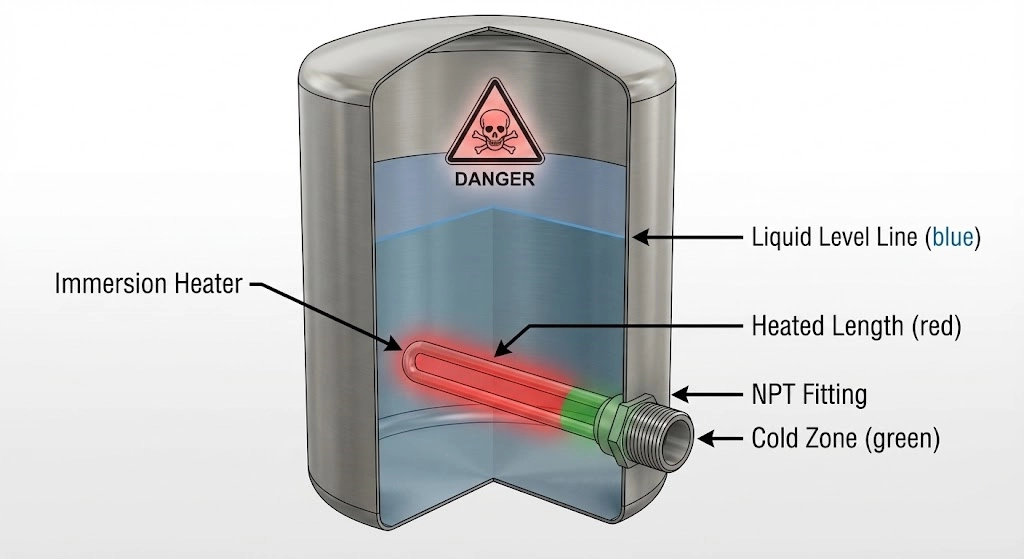
[Visual Element]: A 3D cross-section render of a water tank. It clearly labels the Immersion Heater, the Liquid Level Line (blue), the Heated Length (red), and the critical Cold Zone (green) located just below the NPT fitting. A “Danger” icon hovers over the area where the liquid level drops below the heated zone.
1. The Physics of Liquid Heating: Why “Mold Heaters” Fail Underwater
To select the right heater, you must first understand the hostile environment of a liquid tank.
The Sealing Imperative: Preventing the “Breath”
A standard cartridge heater is designed to “breathe.” As it heats up, air expands out; as it cools, air is drawn back in.
- The Failure Mode: If you submerge a standard heater, it draws in liquid instead of air during the cool-down cycle. This liquid saturates the magnesium oxide (MgO) powder. When the heater powers up again, that trapped liquid instantly turns to steam, expanding 1,600 times in volume. The result is a ruptured sheath (a “blown” heater).
- The Solution: Immersion heaters must be Hermetically Sealed. We use Epoxy potting or Teflon (PTFE) heat-shrink seals at the lead end to create a barrier that is impervious to moisture intrusion.
Watt Density Derating: Water vs. Oil
This is the most common specification error. You cannot use the same power for water and oil.
- Water (The Forgiving Fluid): Water has excellent thermal conductivity and low viscosity. It pulls heat away from the sheath rapidly.
- Max Density: 10 – 15 W/cm² (65 – 100 W/in²).
- Oil (The Viscous Trap): Oils are thick (high viscosity) and conduct heat poorly. If the heater gets too hot, the oil in direct contact “cracks” or carbonizes (coking).
- The Consequence: A layer of carbon builds up on the sheath. Carbon is a thermal insulator. This traps heat inside the core, causing the internal wire to melt.
- Max Density: 3 – 4 W/cm² (20 – 25 W/in²).
- Engineering Takeaway: To heat the same volume of oil as water, you need a heater that is roughly 3x larger (or 3 heaters instead of 1) to spread the wattage over a larger surface area.
The “Scale” Barrier
In tap water or industrial process water, Calcium Carbonate (scale) precipitates onto hot surfaces.
- The Physics: 1mm of scale has the insulating equivalent of 10mm of steel. As scale builds up, the heater must run hotter internally to drive energy through the scale layer into the water. Eventually, the core temp exceeds the limit of the NiCr wire.
2. Structural Selection: Fittings, Orientation, and Cold Zones
How you mount the heater is just as important as what heater you buy.
The NPT Thread Standard
Immersion cartridge heaters are typically integrated with a threaded plug fitting.
- Common Specs: 1/2″ NPT, 3/4″ NPT, M16, or M20 threads.
- The Process: At ht-heater.com, we do not simply screw the heater into the plug. We use TIG Welding (Tungsten Inert Gas) to fuse the stainless steel sheath to the stainless steel fitting.
- Pressure Rating: This welded bond ensures the assembly can withstand tank pressures up to 10 Bar (150 psi) without leaking.
Orientation: Horizontal vs. Vertical
- Recommendation: Horizontal Mounting near the bottom of the tank.
- Why?
- Convection: Heat rises. Bottom mounting ensures natural circulation of the fluid.
- Safety: Vertical mounting poses a risk. If the liquid level drops even slightly, the top of the vertical heater becomes exposed to air (“Dry Firing”) and burns out instantly. Horizontal mounting keeps the heater submerged longer during drainage.
The “Cold Zone” Calculation
The Cold Zone (Unheated Length) is the safety buffer between the fire and the fitting.
Rule: The heated section must never be inside the threaded plug or the tank wall coupling.
Minimum Cold Zone = Thread Length + Tank Wall Thickness + Safety Margin (20mm)
If the heated wire sits inside the brass fitting, the heat cannot escape into the fluid. The fitting will overheat, melting the thread sealant and causing a leak.
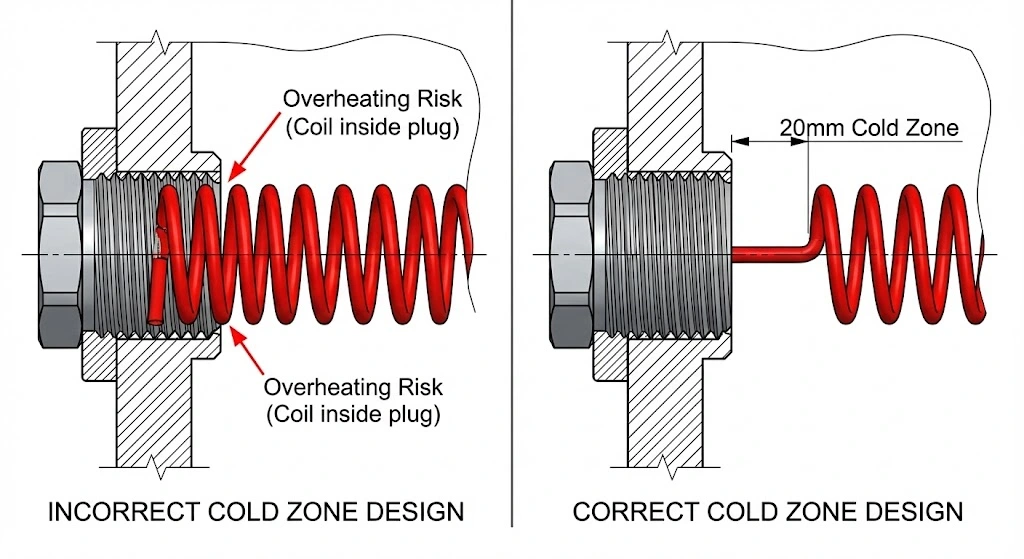
[Visual Element]: A technical diagram comparing “Correct” vs “Incorrect” Cold Zone design. The incorrect side shows the red heating coil extending into the threaded plug (labeled “Overheating Risk”). The correct side shows the heating coil starting 20mm after the plug enters the tank.
3. Material Science: Matching Metallurgy to Media
Stainless steel is not a catch-all. Chloride stress corrosion cracking can destroy 304 stainless in weeks.
Clean Water & Potable Applications
- Material: SS304 or SS316L.
- Why: SS316L is mandatory for food and beverage (FDA compliance) or slightly brackish water, as the Molybdenum content resists pitting.
Hydraulic & Thermal Oils
- Material: Steel or SS304.
- Nuance: For oil, the sheath material is less critical than the Watt Density. Steel is cheaper and sufficient, but SS304 stays cleaner. The focus here must be on keeping density under 4 W/cm².
Corrosive Solutions (Acids/Alkalis)
- Material: Incoloy 800/840 or Titanium.
- Why: Incoloy offers superior resistance to oxidation and chemical attack compared to standard stainless.
- The “Nuclear Option”: For highly aggressive acids (like Sulfuric or Hydrochloric), specify a Teflon (PTFE) Coated sheath. This creates an inert barrier, though it reduces thermal transfer slightly.
4. Troubleshooting: Why Immersion Heaters Die
When a customer returns a failed immersion heater, the damage usually tells us exactly what went wrong.
Failure Mode 1: The “Split” (Burst Sheath)
- Visual: The metal tube has ripped open longitudinally, like a burst sausage.
- Root Cause:
- Moisture Ingress: The seal failed, water entered, turned to steam, and exploded the tube.
- Scale Overload: A thick crust of lime prevented heat escape, causing the internal MgO to expand violently.
Failure Mode 2: Pitting Corrosion
- Visual: Tiny pinholes in the sheath, often with rust streaks.
- Root Cause: Chloride Attack. Using SS304 in water with high chlorine content (e.g., tap water with heavy treatment or pool water).
- Fix: Upgrade to Incoloy 800 or Titanium.
Failure Mode 3: Coking (Black Sludge)
- Visual: The heater is covered in a thick, black, tar-like substance.
- Root Cause: Watt Density too high for the oil viscosity. The heater “burned” the oil.
- Fix: You cannot clean this easily. Replace with a heater that has a larger surface area (lower W/cm²) or increase the oil circulation flow rate.
Quick Reference: Liquid Media & Watt Density
| Media | Recommended Sheath | Max Watt Density (W/cm²) |
| Filtered Water | SS304 / Copper | 15 |
| Tap Water (Hard) | SS316L / Incoloy | 8 – 10 |
| Light Oil (ISO VG 32) | Steel / SS304 | 4 – 5 |
| Heavy Oil (Lube) | Steel / SS304 | 2 – 3 |
| Mild Acid | Incoloy / Titanium | 4 – 6 |
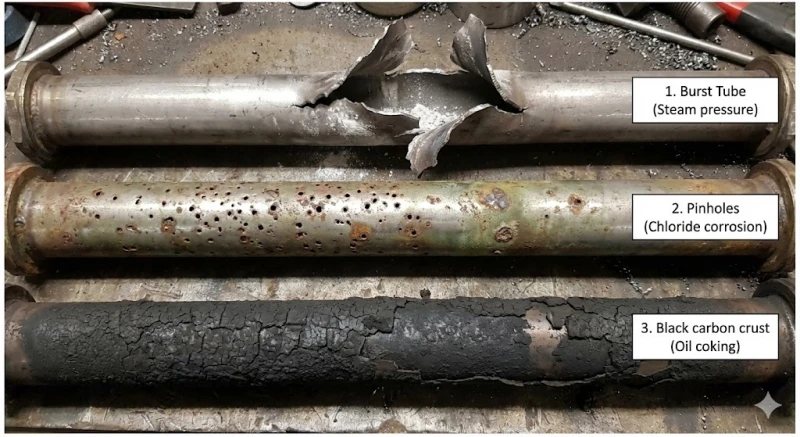
[Visual Element]: A comparison photo of three failed heaters. 1. Burst tube (Steam pressure). 2. Pinholes (Chloride corrosion). 3. Black carbon crust (Oil coking).
5. Maintenance: Extending Service Life
Immersion heaters are not “install and forget.”
- The Descaling Schedule: In hard water areas, pull the heater every 3 months. If scale is visible, soak the element in a Citric Acid or Vinegar solution. Do not scrape with a wire brush, as this damages the passivation layer of the stainless steel.
- Level Sensor Interlock: Human error (forgetting to refill the tank) is the #1 killer. Always wire a Float Switch in series with the heater contactor. If the liquid drops, power cuts instantly.
- Sludge Removal: In oil tanks, sludge settles at the bottom. If the heater is buried in sludge, it will overheat. Mount heaters at least 50mm above the tank floor.
FAQ: Immersion Heater Specifics
Can I fully submerge a cartridge heater (including the leads)?
No, not with a standard build. Standard fiberglass leads will wick water into the heater via capillary action, causing a short circuit. Exception: We can manufacture fully submersible heaters using a vulcanized silicone rubber connection or a welded stainless steel flexible conduit. This must be specified at the time of order.
Why is my oil heater twice as long as my water heater for the same wattage?
This is physics at work. Because oil cannot absorb heat as fast as water, we must lower the “intensity” of the heat (Watt Density). To keep the total power (Watts) the same while lowering the intensity (W/cm²), we must increase the surface area. This means making the heater longer or larger in diameter.
Do I need Teflon tape (Plumber’s Tape) on the NPT fitting?
Yes. While NPT (National Pipe Taper) threads are designed to crush together to form a seal, high-temperature fluctuations can cause minor expansion gaps. Always apply High-Temp PTFE Tape or a liquid pipe sealant compatible with your fluid to ensure a leak-free joint.