Introduction & The 360° Trap
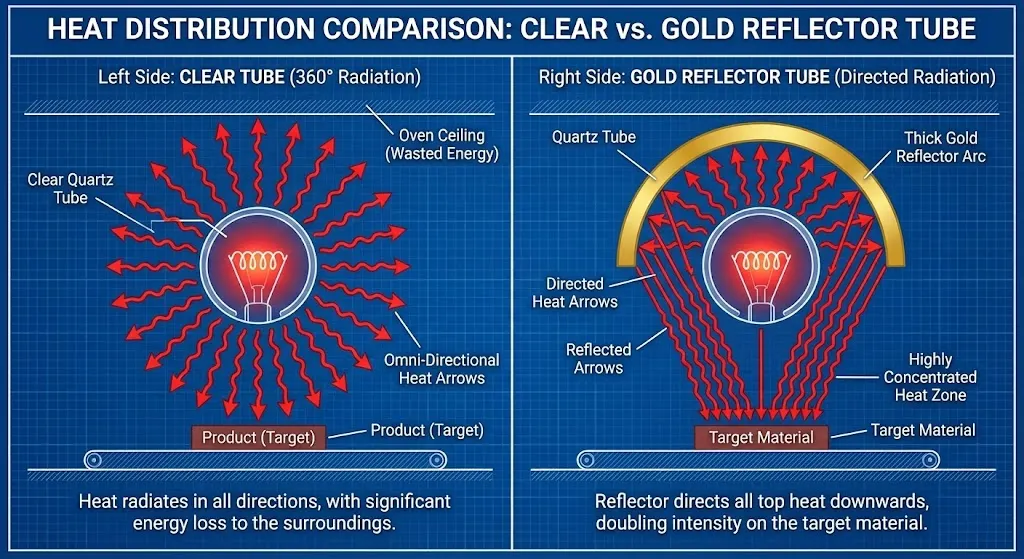
Walk into any aging industrial facility, and you will likely find curing ovens operating at a massive disadvantage. Inside these ovens, standard clear quartz heating tubes emit infrared radiation in a 360° radial pattern.
This means that without any optical intervention, exactly 50% of your electrical energy is actively being used to heat the ceiling of the oven, the machine frame, or the sensitive wiring terminals located behind the heating elements. This “360° Trap” is not just a colossal waste of electricity; the scattered thermal energy prematurely degrades internal machine components, forcing expensive and frequent maintenance shutdowns.
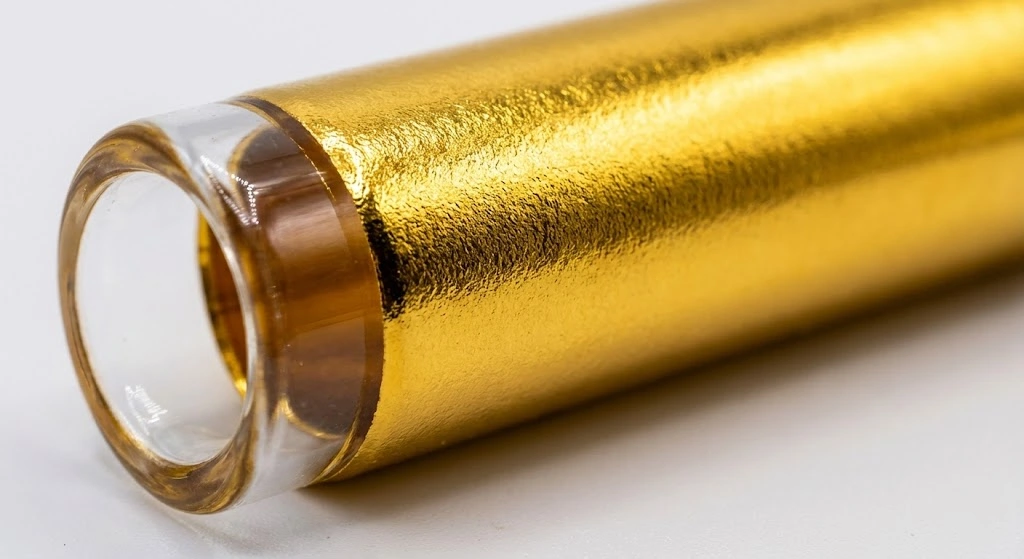
The engineering solution to this inefficiency is the Gold-Coated Quartz Heater. By sintering a microscopic layer of real gold directly onto the rear hemisphere of the quartz tube, we create an integrated reflector. This coating intercepts the escaping infrared waves and effectively “bounces” them back toward your target product, instantly converting a 360° scattergun into a focused 180° Directional Heating instrument.
Engineering Context: Integrating a reflector directly onto the tube is just one way to optimize thermal dynamics. To understand how this fits into the broader spectrum of infrared selection—including wavelength matching and filament types—please refer to our foundational guide: Industrial Quartz Heating Tubes: The Complete Engineering Guide
The Physics of Gold Reflection: Why Not Aluminum?
When optimizing thermal dynamics, engineers must look beyond structural metals and focus on optical properties. Why do we insist on using an expensive precious metal like gold instead of highly polished aluminum or silver?
1. The Superior Optical Properties of Gold
In the infrared spectrum—specifically within the critical industrial bands of 1.0μm to 4.0μm—gold is the undisputed champion of reflectivity. While polished aluminum tops out at roughly 85-90% reflectivity, pure gold reflects over 95% of infrared radiation. Furthermore, unlike silver, gold is highly inert. It will not tarnish, oxidize, or degrade its optical properties when exposed to atmospheric oxygen at high temperatures.
2. Thermal Masking (Reverse Heat Protection)
The gold layer serves a dual purpose. It is not merely a mirror pushing energy forward; it is a Thermal Shield protecting the rear. By reflecting 95% of the energy, the gold coating ensures that the area directly behind the heating tube remains significantly cooler. This “Thermal Masking” is vital for protecting delicate thermocouple wiring, ceramic terminal blocks, and the oven insulation itself from direct radiant heat damage.
Specifications & Underlying Compatibility
The beauty of the gold reflector is that it is an optical enhancement, completely agnostic to the actual heating engine inside the tube.
1. Spectrum Agnostic Integration
Whether your process requires the deep, instant penetration of a Tungsten Halogen filament (Short Wave) or the gentle, highly absorptive heat of a Carbon Fiber filament (Medium Wave), the gold coating can be applied.
- Example Specs: We routinely manufacture medium-wave gold-coated tubes featuring a Peak Wavelength of 2.2-3.5 Microns and a Color Temperature of 1800K, optimizing both the emission spectrum for plastics and the directional efficiency via the reflector.
2. Physical Geometries & Power Density
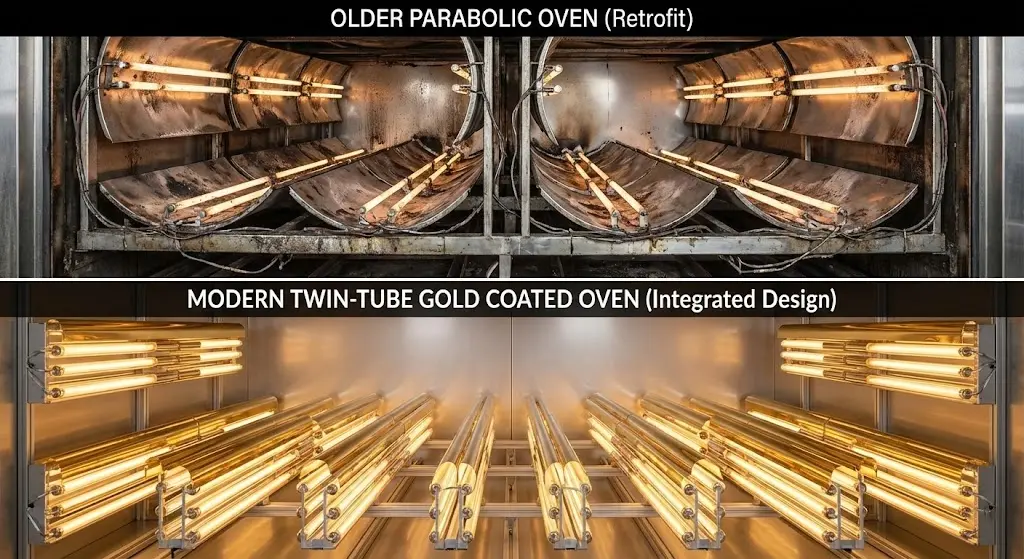
The gold coating process is highly adaptable to complex shapes. We apply it to standard Single Tubes, but its true potential is unlocked when applied to Twin Tubes (Figure-8 design). A gold-coated Twin Tube offers a much wider, flatter reflective surface area compared to a single round tube, resulting in an even more uniform distribution of the reflected heat field. Additionally, the twin-tube structure provides superior mechanical rigidity across long spans (up to 3000mm) without sagging.
Integrated vs. External Reflectors: Engineering Advantages
Many oven designers attempt to solve the 360° problem by building large, polished stainless steel or aluminum reflectors behind bare quartz tubes. Here is why the integrated gold coating makes the external reflector obsolete.
1. Space Optimization (High-Density Heating)
Bulky external parabolic reflectors consume massive amounts of valuable real estate inside a machine. If you are designing a compact semiconductor processing tool or a tight lamination line, space is at a premium. An integrated gold coating adds zero millimeters to the outer diameter of the tube. This allows engineers to pack heating elements closer together, drastically increasing the power density (W/cm²) within a confined footprint.
2. Maintenance Reduction & Dirt Masking
The fatal flaw of an external stainless steel reflector is dust. In a typical factory environment, airborne particulates, paint fumes, or plastic off-gassing will settle on the external reflector. Within weeks, its reflectivity drops from 80% to 40%. It becomes a heat sink instead of a mirror, requiring maintenance teams to frequently dismantle the oven and polish the metal. In contrast, the integrated gold layer is sintered directly onto the quartz glass, which operates at temperatures high enough to burn off most organic contaminants. It is physically impossible for dust to get between the heat source and the reflector.
Limitations & Engineering Alternatives: The Honest Truth
At Hongtai, we practice value-driven engineering. This means telling you when our premium product is not the right choice for your specific environment.
1. The High-Temperature Bottleneck of Gold
While gold boasts the highest reflectivity, it has a strict thermal limit. If the ambient temperature inside your enclosed oven cavity routinely exceeds 600°C to 700°C, the gold layer will begin to degrade. Over time, extreme ambient heat causes the gold molecules to diffuse into the quartz glass or evaporate entirely, leaving the tube bare.
2. The Alternative: Ceramic White Processing (Half-White)
If you are designing a high-temperature furnace, or if your procurement budget cannot justify the cost of precious metals, we offer a robust alternative: Ceramic White Reflectors. By coating the back half of the tube with a proprietary nano-ceramic white glaze, we provide excellent directional heating.
- The Trade-off: The reflectivity of ceramic white is slightly lower (roughly 85-90% compared to gold’s 95%+).
- The Advantage: The ceramic coating can withstand ambient furnace temperatures exceeding 900°C without peeling or degrading, making it the ultimate choice for extreme thermal environments.
Ideal Use Cases: Where Gold Reflectors Dominate
Scenario 1: Semiconductor & Photovoltaic Manufacturing (RTP)
In Rapid Thermal Processing (RTP) systems for silicon wafers, engineers require intense, perfectly uniform heat delivered in a compact vacuum chamber without any metallic contamination. Gold-coated high-purity quartz tubes provide the highest possible watt density with an incredibly small physical footprint, precisely directing energy onto the wafer.
Scenario 2: High-Speed Printing & Paper Drying
In commercial printing presses, the paper web runs at blistering speeds and must absorb massive amounts of heat instantly to dry the ink. However, the steel rollers and delicate optical sensors located just millimeters behind the heaters must remain cool to prevent mechanical failure. The gold reflector’s “Thermal Masking” capability is the only way to satisfy this extreme front-to-back temperature differential.
FAQ: Common Questions on Directional Infrared Technology
Does the gold coating peel off over time?
No. Our gold reflectors are not simply painted on; the liquid gold compound is applied and then fired in a high-temperature kiln, initiating a Sintering process that permanently bonds the gold molecules to the silica structure of the quartz glass. Provided the ambient oven temperature remains within the rated limits (<600°C), it will not peel or flake.
Can I clean a gold-coated quartz heater?
Yes, but with strict precautions. Cleaning must only be performed when the tube is completely unpowered and cold. Use a lint-free cloth lightly dampened with Isopropyl Alcohol. Never use abrasive pads, steel wool, or harsh chemical degreasers, as these will scratch the gold layer and destroy its optical reflectivity.
How much electrical energy does a gold reflector actually save?
While the exact number depends on your oven’s geometry, field data shows that replacing bare tubes with gold-coated tubes increases the thermal absorption of the target product by 30% to 40%. Consequently, engineers can lower the power output via their SCR controllers by a proportionate amount to achieve the exact same curing results, resulting in massive direct electricity savings.
Conclusion: Upgrade Your Efficiency Today
Improving your thermodynamic efficiency does not always mean pulling more amps from the grid or buying larger heating elements. More often than not, optimization is simply about capturing the energy you are already paying for and forcing it to do the work.
A Gold-Coated Quartz Heater is the most direct, high-ROI hardware upgrade you can make to an existing thermal system. You eliminate the need for bulky external metal reflectors, you protect your internal wiring from heat fatigue, and you focus every watt of energy directly onto your product.
Stop heating your ceiling. Focus your energy. Send a photograph of your current oven interior or your engineering drawings to the Hongtai Thermal Engineering team. We will analyze your setup and provide a custom Energy Savings Projection, showing you exactly how much electricity you can save by upgrading your bare elements to integrated directional reflectors.