Introduction
A standard cartridge heater is a workhorse, but it isn’t a magic wand. If you drop a standard mold heater into a water tank, it will likely explode within hours. If you connect a 12V 3D printer heater to a 24V supply using thin wires, you risk melting your cabling.
In the world of industrial heating, context is everything.
This guide acts as the “Advanced Spec Sheet” companion to our [Ultimate Cartridge Heater Guide]. While our previous guide covered the basics of watt density and fit, this article dives deep into the 5 specific variations of cartridge heaters: from the precision of built-in thermocouples to the rugged requirements of immersion heating and the high-current demands of low-voltage (12V/24V) applications.
By the end of this guide, you will know exactly how to configure a heater that survives your specific environment—whether it’s underwater, in a vacuum, or moving at 100 cycles per minute.
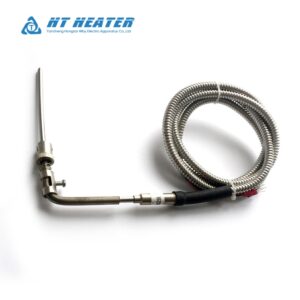
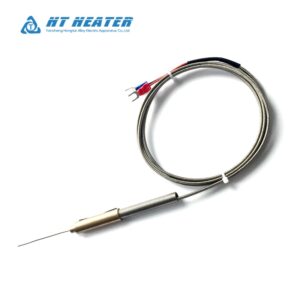
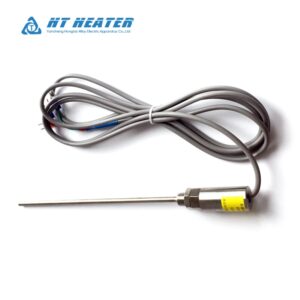
1. Built-in Thermocouple Heaters: Precision Control to ±1°C
The Problem: External sensors are slow. By the time a thermocouple mounted on the mold surface detects a temperature drop, the heater core might already be overheating by 100°C.
The Solution: Internal temperature sensing.
J-Type vs. K-Type: Which Sensor Do You Need?
Choosing the right thermocouple calibration is critical for controller compatibility.
| Type | Calibration | Temp Range | Pros & Cons |
| Type J | Iron / Constantan | 0 – 750°C | High Sensitivity. Best for plastics and rubber molding. Note: Iron leg can rust. |
| Type K | Chromel / Alumel | 0 – 1250°C | Industry Standard. Excellent oxidation resistance. Lower sensitivity than Type J but wider range. |
Grounded vs. Ungrounded Junctions
- Grounded (Fast Response): The thermocouple junction is welded directly to the heater sheath.
- Pros: Instantaneous thermal feedback.
- Cons: Susceptible to electrical noise (EMI) from the heater coil; can trip sensitive controllers.
- Ungrounded (Clean Signal): The junction floats in the MgO insulation, electrically isolated from the sheath.
- Pros: Immune to electrical noise; safer for PID controllers.
- Cons: Slight thermal lag (seconds).
Why use internal sensors?
Internal sensors protect the heater, not just the process. They allow you to set a “High Limit” alarm that cuts power if the heater core exceeds its safety rating, preventing burnout even if the mold is cold.
2. Immersion Cartridge Heaters: The Rules of Liquid Heating
The Problem: Water is a better conductor than air, but it brings new enemies: corrosion, pressure, and scale (calcium buildup).
NPT Fittings and TIG Welding
You cannot simply “glue” a heater into a tank. Immersion heaters require a threaded fitting (usually Brass or Stainless Steel) to create a watertight seal.
- Standard Threads: 1/2″ NPT, 3/4″ NPT, or BSP equivalents.
- The Seal: At ht-heater.com, we use TIG welding to fuse the flange to the sheath, pressure-tested to 10 Bar (150 psi) to ensure zero leakage.
Material Upgrade: Incoloy 800 vs. 304
- SS304: Acceptable for clean, fresh water.
- Incoloy 800 / SS316L: Mandatory for hard water, chemical solutions, or anywhere “Scale” is a risk. Scale acts as an insulator; if it coats the tube, the heat can’t escape, and the heater will rupture.
The “Cold Zone” Survival Rule
Critical Check: The heated section of the tube must NEVER extend above the liquid level.
- If the water level drops and exposes the heated wire, it will glow red and fail instantly (“Dry Firing”).
- Design Tip: Specify a Cold Zone (Unheated Length) of at least 25-50mm below the flange to account for liquid level fluctuations.
3. Low-Voltage (12V/24V) Heaters: 3D Printers & Battery Power
The Problem: High current. Engineers often forget that as voltage drops, amperage skyrockets.
The Current Trap (Ohm’s Law)
Consider a 60W heater:
- At 220V, Current = 0.27 Amps (Thin wires are fine).
- At 12V, Current = 5.0 Amps (Requires heavy-gauge wire).
Warning: Using standard thin leads on a 12V heater will cause the wires to heat up, melt the insulation, and potentially start a fire. Always specify High-Amperage Teflon or Silicone Leads (min 18 AWG or 0.75mm²) for low-voltage applications.
3D Printing Standards (RepRap / E3D)
For 3D printer hot-ends, size and speed are key.
- Common Size: 6mm diameter x 20mm length.
- Performance: Requires high-purity MgO to ensure rapid “Ramp-Up” times (room temp to 200°C in <60 seconds).
4. Miniature & Square Heaters: Solving Space Constraints
The Problem: Standard round heaters don’t fit into thin plates or milled slots efficiently.
Pencil Heaters (Dia < 3mm)
Manufacturing a heater as thin as a pencil lead requires specialized winding technology.
- Application: Micro-fluidics, medical device heating, and semiconductor bonding.
- Constraint: Due to the tiny amount of insulation, Voltage must often be limited (usually < 48V) to prevent internal arcing.
Square Cartridge Heaters
- The Physics: A round heater in a round hole has “line contact.” A square heater in a milled slot has “face contact” on three sides.
- The Benefit: Significantly better heat transfer allows for higher watt densities and longer life in tooling plates and sealing bars.
5. Termination Styles: Connecting Power in Tough Spots
How the wires exit the heater determines its mechanical durability.
Swaged-in vs. Crimped-on Leads
- Crimped-on (Standard): Wires are connected to solid pins outside the heater.
- Weakness: The connection point is rigid. If the wire is bent sharply, it snaps.
- Swaged-in (Vibration Proof): The flexible lead wires enter deep into the heater body and are swaged (compressed) along with the MgO.
- Strength: The wire exit is fully flexible. This is Mandatory for moving machinery like packaging sealing jaws or cutting knives.
Right Angle (90°) Exits
When you don’t have space for straight leads:
- Right Angle Tube: A bent metal tube protects the leads. Rugged and waterproof.
- Right Angle Block: A compact steel block welded to the end. Best for extremely tight spaces where every millimeter counts.
Armor & Braiding
- Stainless Steel Braid: Protects leads from abrasion (rubbing against machine parts).
- Stainless Steel Armor (Hose): Provides maximum protection against crushing, cuts, or rodent damage.
[Image Gallery of 4 termination styles: 1. Swaged-in leads (flexible), 2. Right Angle Block (tight space), 3. Stainless Steel Braid (abrasion resistant), 4. Threaded Post Terminals]
6. Spec Checklist: How to Order the Perfect Custom Heater
Don’t leave the factory guessing. When sending an inquiry to ht-heater.com, copy and paste this checklist:
- [ ] Diameter & Tolerance: (e.g., 12mm -0.02/-0.06mm)
- [ ] Overall Length: (Include or exclude the lead exit?)
- [ ] Voltage / Wattage: (Check your power supply!)
- [ ] Termination Style: (Swaged-in, Crimped, or Right Angle?)
- [ ] Lead Length: (Standard is 250mm; do you need 1000mm?)
- [ ] Special Features: (Thermocouple J/K? Flange? Thread?)
FAQ: Common Selection Questions
Can I use a standard cartridge heater to heat water?
No. Standard heaters are designed for dry mold fit (high watt density). In water, they will scale up and explode due to poor heat dissipation through the scale. You must use an Immersion Cartridge Heater with a welded flange and lower watt density.
J-Type or K-Type Thermocouple?
If you are molding standard plastics (ABS, PE) under 500°C, Type J is accurate and reliable. For higher temperatures or if you are unsure of the controller type, Type K is the safer, more universal choice.
Can I run a 12V heater on 24V to make it heat faster?
Dangerous. Doubling the voltage quadruples the wattage ($P = V^2/R$). A 40W heater will try to pull 160W, likely melting the internal wire instantly. Always match the rated voltage.
Why choose Swaged-in leads?
Choose Swaged-in leads if your heater is mounted on a moving part. The internal connection eliminates the rigid “weak point” found in standard crimped heaters, preventing wire breakage from constant flexing.