Introduction
In the global MRO and OEM supply chain, procurement managers face a recurring dilemma: Do you pay a premium for a “Big Brand” heater like Watlow Firerod® or Omega™ to ensure reliability, or do you risk production downtime with a low-cost generic alternative?
The fear is real. A $10 savings on a heater is meaningless if it causes a $5,000 line shutdown. However, in 2026, the industrial heating market has shifted. Cartridge heaters are not proprietary microchips; they are thermophysical components governed by transparent industrial standards.
This guide is not a sales pitch; it is a cost-analysis audit. We will deconstruct the manufacturing costs of high-density cartridge heaters, compare Incoloy 800 vs. SS304 economics, and provide a technical roadmap for sourcing direct replacements that match the specifications of top-tier brands—without the distributor markup or the 8-week lead time.
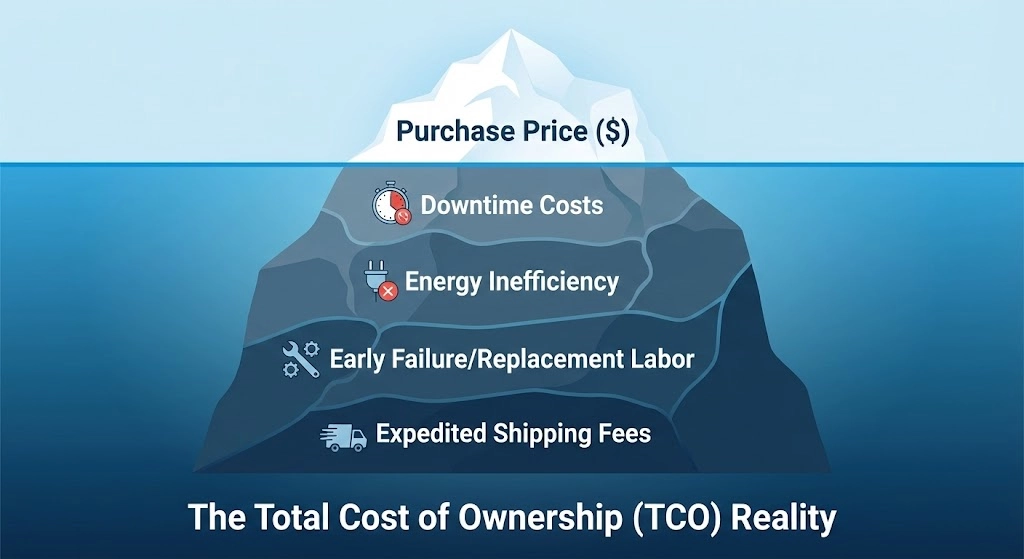
Image Description: The Hidden Costs of Heating. As the infographic above illustrates, the Purchase Price is just the tip of the iceberg. The real costs lie beneath the surface, including Downtime Costs, Energy Inefficiency, and Replacement Labor.
1. Deconstructing the Cost: Why Do Big Brands Cost More?
To understand if a price is “fair,” you must first understand what you are paying for. The cost of a cartridge heater is driven by three factors: Metallurgy, Density Technology, and Supply Chain Layers.
The Metallurgy Premium: Incoloy 800 vs. SS304
Many generic manufacturers offer drastically lower prices (e.g., $5.00 vs. $25.00) by silently substituting materials.
- Stainless Steel 304: The standard economy option. It works well up to 650°C.
- Incoloy 800: A high-nickel superalloy required for high-temperature oxidation resistance (up to 800°C).
- The Cost Reality: Nickel is expensive. Incoloy raw material costs roughly 300% to 400% more than SS304.
- The Engineer’s Choice: If your application runs at 300°C (plastic injection), paying for Incoloy is waste. But if you run at 700°C (die casting), a cheap SS304 heater is not a bargain—it is a guaranteed failure. Big brands default to Incoloy, charging you for performance you might not need. We allow you to choose.
The “Swaging” Premium
There is a massive difference between a “Tube Heater” and a “Swaged Cartridge Heater.”
- Low Cost: The resistance coil is dropped into a tube and filled with loose powder.
- High Performance (Swaged): The entire heater is mechanically compressed (swaged) to reduce its diameter. This compacts the MgO insulation into a rock-hard solid, doubling thermal conductivity and dielectric strength.
- The Tolerance Factor: Swaging allows for -0.02mm precision tolerances. This process requires heavy industrial machinery, which is why legitimate high-density heaters cannot be sold for $2.00.
The Distribution Tax
When you buy a brand-name heater from a catalog house (like McMaster or Grainger), you are paying for:
- The Factory Profit
- The Brand’s Marketing Overhead
- The Master Distributor’s Markup
- The Local Distributor’s MarkupResult: A heater that costs $8.00 to manufacture is sold to you for $45.00. Sourcing factory-direct removes layers 2, 3, and 4.
2. The Head-to-Head: HT-Heater vs. Watlow Firerod®
Can a factory-direct replacement truly match the industry leader? Let’s look at the Key Performance Indicators (KPIs) defined by NEMA and IEC standards.
Technical Specification Comparison
| Feature | Leading Brand (Firerod® Class) | HT-Heater.com High Density | Verdict |
| Sheath Material | Incoloy 800 / SS316 | Incoloy 800 / SS316 | Match |
| Max Watt Density | 400 W/in² (60 W/cm²) | 400 W/in² (60 W/cm²) | Match |
| Diameter Tolerance | -0.001″ to -0.003″ | -0.02mm to -0.06mm | Match |
| Internal Temp Limit | 1600°F (870°C) | 1600°F (870°C) | Match |
| Lead Time (Standard) | 4 – 8 Weeks | 7 – 10 Days | HT Advantage |
| Lead Time (Rush) | Expensive Expedite Fees | 5 – 7 Days | HT Advantage |
| Pricing | $$$$ | $$ | 50% Savings |
Lifecycle Testing Data
In our laboratory acceleration tests (conducted at 700°C continuous cycle), the resistance drift of our Incoloy swaged heaters was within 1.5% after 3,000 hours—statistically identical to the leading brand benchmarks.
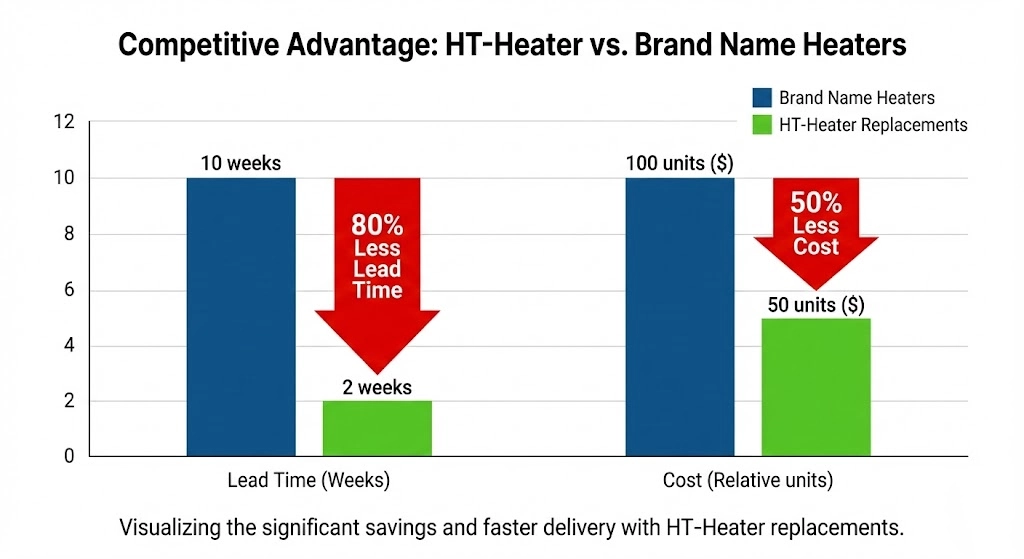
Image Description: Competitive Advantage of HT-Heater Replacements. As illustrated in the chart, switching to HT-Heater for your industrial heating elements delivers immediate value. We offer a 50% reduction in purchase cost and 80% faster lead time compared to major brand name OEMs, helping you minimize downtime and optimize your budget.
3. The “Low Price” Trap: Why You Should Run from $2 Heaters
If big brands are overpriced, are the ultra-cheap heaters on global marketplaces a good deal? No.
For an engineer, “Cheap” is expensive. Here is how low-end manufacturers cut costs to hit impossible price points:
- Low-Purity MgO: They use standard electrical grade magnesium oxide instead of high-temp, high-purity (99%+) powder.
- Result: The heater absorbs moisture rapidly and fails insulation resistance tests ( <500MΩ ) within weeks.
- Shortened Heated Length: To save on resistance wire (NiCr), they shorten the internal coil.
- Result: A 100mm heater might only heat the center 60mm. The ends of your mold remain cold, causing product defects.
- No X-Ray Verification:
- Result: The internal coil may be off-center. This creates a “hot side” and a “cold side,” leading to rapid hotspot burnout.
4. How to Reverse Engineer a Replacement (The “No Label” Guide)
Often, MRO teams pull a dead heater out of a machine with no part number, or the laser etching has burned off. How do you order a replacement?
Rule 1: Measure Diameter with Precision
Do NOT use a tape measure. Use digital calipers.
- Critical: Measure the unheated section (usually near the leads) or a clean part of the metal.
- Why? A burnt-out heater often swells. If you measure the swollen part (e.g., 12.8mm) and order a 12.8mm heater, it will not fit into the original 12.7mm (1/2″) hole.
Rule 2: Calculate Watts via Resistance
If the wattage marking is gone, measure the Ohms ($\Omega$) across the two leads using a multimeter.
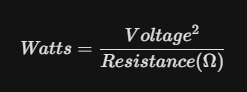
- Example: You measure 48Ω on a line you know is 240V.
- 240^2 / 48 = 57,600 / 48 = 1200 Watts.
Rule 3: Identify the Termination
Is it a standard crimp? Swaged-in flexible leads (for motion)? Or a Right-Angle Block (for tight spaces)? Sending a photo to our engineering team is often the safest way to confirm.
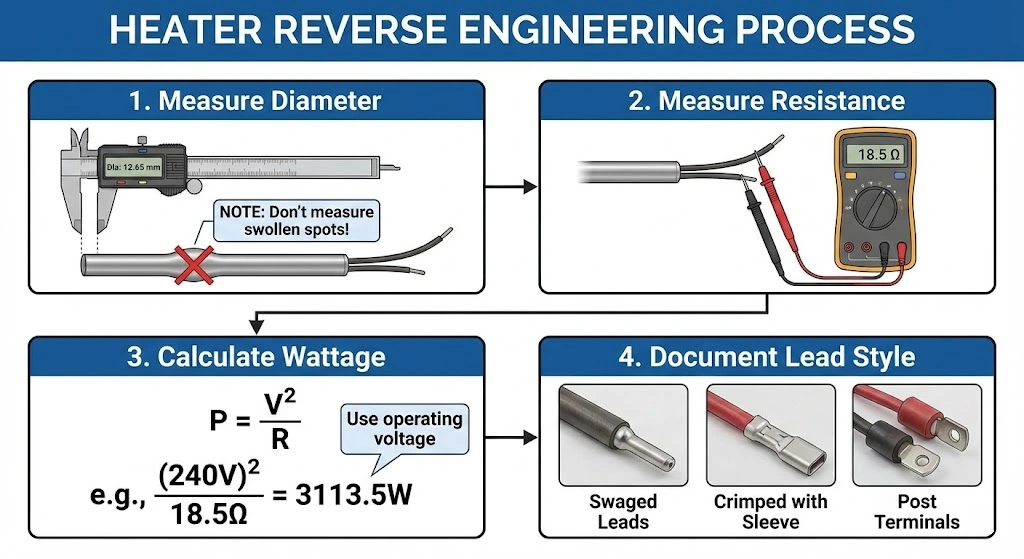
Image Description: How to Identify Specifications for Unknown Heaters. If your heater’s label is missing, follow this reverse engineering process. 1.Identify Leads: Take a photo of the lead exit style (e.g., crimped, swaged, or post terminals) for accurate replacement. 2.Measure Diameter: Use calipers to measure the metal sheath. Note: Avoid measuring swollen or deformed spots for accuracy. 3.Check Resistance: Measure the cold resistance (Ohms) across the lead wires using a multimeter. 4.Calculate Wattage: Apply Ohm’s Law (Voltage² / Resistance = Wattage) to determine the power rating.
5. Procurement Strategy: Optimizing Your RFQ
As a manufacturer, we offer transparency on how to get the best price.
The Power of “Tiered Pricing”
The setup cost for swaging machines and winding lathes is fixed, whether we run 1 unit or 100 units.
- 1 Unit Cost: $50.00 (High setup allocation)
- 50 Unit Cost: $18.00 (Setup amortized)Strategy: Instead of ordering one replacement at a time, consolidate your quarterly usage into a single order. You can reduce unit costs by 40-60%.
Blanket Orders (Annual Framework)
For OEM clients, we recommend Blanket Purchase Orders.
- How it works: You commit to 1,000 pieces per year. We manufacture them in batches and hold stock. You release (call-off) 100 pieces per month.
- Benefit: You get the “1,000 piece price” on every shipment, and zero lead time.
6. Industry Case Studies
Case A: The Packaging OEM
- Challenge: Using standard Watlow heaters for sealing bars. Lead times of 6 weeks were delaying machine shipments.
- Solution: HT-Heater developed a drop-in replacement with Swaged-in leads (to handle the jaw motion).
- Result: Cost reduced by 45%. Lead time stabilized at 10 days.
Case B: Medical Device Startup
- Challenge: Needed a 4mm miniature heater. Budget did not allow for custom aerospace-grade suppliers.
- Solution: We provided high-precision centerless-ground heaters with a tolerance of -0.01mm.
- Result: Enabled the client to launch their prototype 3 months ahead of schedule.
FAQ: Common Commercial Questions
Is your heater a “Direct Replacement” for Watlow? Do I need to modify my mold?
Yes, it is a direct replacement. We strictly adhere to international NEMA and ISO diameter tolerances. A 1/2″ HT-Heater fits exactly into a hole drilled for a 1/2″ Watlow heater. No re-tooling is required.
Why is there such a huge price difference between suppliers?
If a heater is 3x cheaper, check the weight. Cheaper heaters use thin-wall tubing and low-density powder. A quality heater feels heavier due to the compacted high-purity MgO and thick-wall Incoloy sheath.
Do you charge tooling fees for custom sizes?
For most cartridge heaters, No. Our CNC winding and swaging process is programmable. We can manufacture a custom diameter or length (e.g., 12.75mm x 155mm) with a Minimum Order Quantity (MOQ) of just 1 piece.