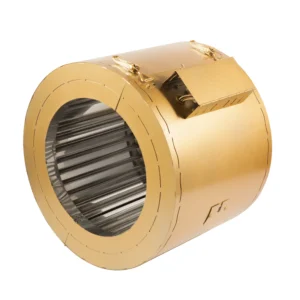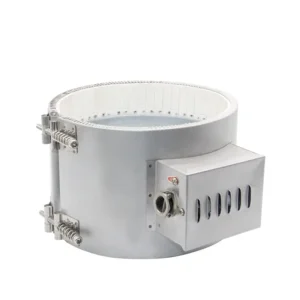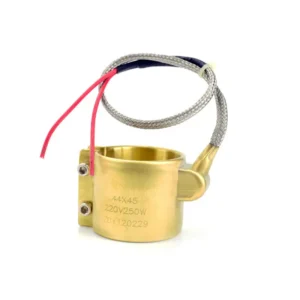
It is a frustrating reality in thermal engineering: the heating element itself—the internal NiCr resistance ribbon and the dielectric insulation—is often still perfectly functional when a heater is declared “dead.” In industrial field audits, nearly 40% of band heater failures are traced back to the electrical interface rather than the heating core. Whether it is a frayed lead wire, an oxidized post terminal, or a melted plug, the termination is frequently the weakest link in the electrical circuit.
In high-vibration extrusion environments or high-heat ceramic applications, selecting a termination is not a matter of convenience; it is a matter of environmental resistance. This guide moves beyond the heater band to analyze the critical “last inch” of the connection. We will dissect the material limits of fiberglass vs. Teflon leads, the mechanical protection of armor cabling, and the ROI of quick-disconnect European plugs.
For engineers specifying new equipment or maintenance leads optimizing Mean Time To Repair (MTTR), understanding these interfaces is vital for preventing unscheduled downtime. Before finalizing your termination specs, ensure you have selected the appropriate heater base by reviewing our [Ceramic vs. Mica Band Heater Guide].
1. The Physics of Electrical Failure at High Temperature
Standard electrical logic, suitable for ambient-temperature wiring, often fails when applied to industrial heating. The primary antagonists are thermal oxidation and dielectric degradation.
Thermal Oxidation and Resistance
Most band heaters cycle between ambient factory temperatures and operational setpoints of 300°C to 600°C. This repeated thermal cycling accelerates the oxidation of metallic conductors. As copper or nickel-plated steel oxidizes, a non-conductive layer forms on the surface of the connection.
This layer increases contact resistance ($R$). According to Joule’s First Law ($P = I^2R$), increased resistance generates localized heat at the terminal. This creates a “runaway” loop: more heat causes more oxidation, which increases resistance, eventually causing the terminal to melt, weld itself shut, or arc to the grounded sheath.
Dielectric Strength and Arcing
In environments where plastic blowback or oil mist is present, contaminants can settle on the termination point. At high temperatures, these organic substances carbonize. Carbon is a semiconductor; its presence reduces the dielectric gap between terminals. Once the gap is compromised, the high-voltage current jumps the air gap—a phenomenon known as arcing—which vaporizes the terminal and poses a significant fire risk.
2. Lead Wire Terminations: Flexibility vs. Protection
Lead wires offer the highest degree of installation flexibility, allowing wires to be routed through tight machine guards. However, the choice of “skin” for these wires dictates their lifespan.
Fiberglass vs. Teflon (PTFE) Insulation
- Fiberglass: The industrial standard for high-heat zones. It can withstand continuous exposure to 450°C. It is mandatory for ceramic band heaters where the ambient air near the heater often exceeds 300°C. Its weakness is porosity; it does not protect against oil or moisture.
- Teflon (PTFE): Superior for chemical resistance and moisture-proof applications. However, Teflon has a strict physical ceiling of 250°C. If used on a high-watt-density ceramic band, the insulation will soften, off-gas, and eventually fail, leading to a short circuit.
Stainless Steel Braid vs. Armor Cable
In the 2026 manufacturing environment, mechanical protection is non-negotiable for OHS (Occupational Health and Safety) compliance.
- Stainless Steel Braid: Provides excellent flexibility and moderate abrasion resistance. It is the preferred choice for heaters on dynamic extrusion heads that require frequent repositioning.
- Armor Cable (Flexible Conduit): Offers maximum protection. It protects the leads against falling tools, heavy abrasion, and accidental compression. It is less flexible than braid and requires more clearance for the bend radius.
3. Post Terminals: The Heavy-Duty Standard
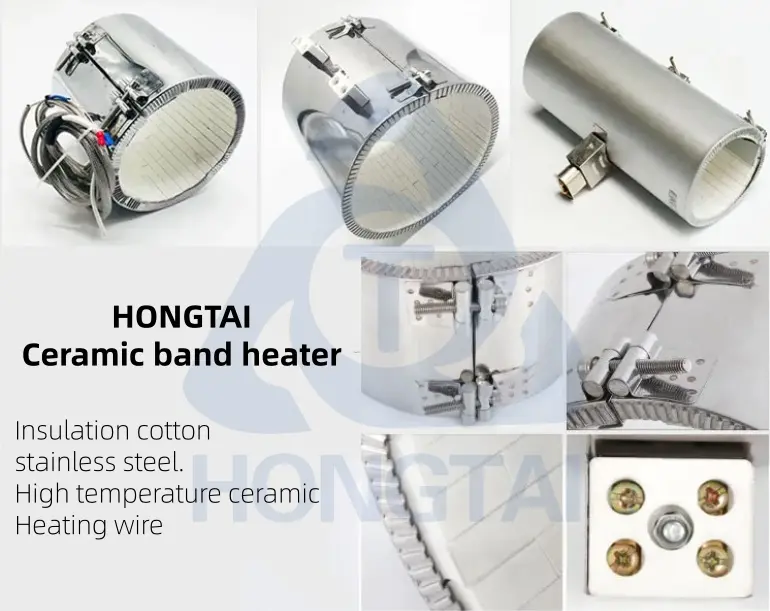
Post terminals (screw terminals) are the traditional choice for high-amperage ceramic band heaters and large-diameter mica bands. They provide a high-torque, low-resistance connection point.
Why Nickel-Plated Hardware is Non-Negotiable
Cheap zinc-plated steel hardware will degrade rapidly at temperatures above 200°C. The zinc “sacrifices” itself, leading to rapid corrosion and making the nuts impossible to remove during maintenance. Hongtai utilizes high-grade Nickel-Plated Steel or Stainless Steel posts and nuts. Nickel maintains its metallurgical integrity at high temperatures, preventing terminal “welding” and ensuring the hardware can be loosened even after years of service.
The “Double-Nut” SOP for Secure Fastening
One of the most common maintenance errors is applying torque to the top nut without securing the base. This twists the terminal post, which is welded to the fragile NiCr wire inside.
- The SOP: Always use two wrenches. One wrench must hold the bottom nut stationary against the heater body to protect the internal connection. The second wrench is used to tighten the power lead between the two nuts. This “Double-Nut” method ensures a high-pressure connection without risking internal mechanical failure.
4. Terminal Boxes: Sealed Protection for Harsh Zones
A terminal box acts as a localized “safe room” for your electrical connections, shielding them from the external environment.
NEMA and IP Ratings for Heaters
In food-grade or wash-down environments, unshielded terminals are unacceptable.
- Standard Boxes: Typically made of folded stainless steel, providing mechanical protection and basic dust resistance.
- Sealed Boxes: Feature high-temperature gaskets and sealed conduit entries. These are necessary to meet IP65 standards in facilities where machinery is frequently sprayed with cleaning agents or subjected to heavy oil mist.
Low-Profile Solutions
For heaters located under machine guards or inside compact molds where vertical clearance is less than 25mm (1 inch), standard terminal boxes are too bulky. In these scenarios, engineers should specify Low-Profile Terminations, which use a flattened terminal housing to provide protection while maintaining a slim physical footprint.
5. European Style Plugs: The Quick-Disconnect ROI
Mean Time To Repair (MTTR) is a critical KPI for 24/7 production lines. Rewiring a terminal block can take 15–30 minutes per zone; a plug-based system reduces this to seconds.
Standardizing the 2-Pin and 3-Pin Interface
European-style plugs (often referred to as “Heater Plugs”) utilize a high-temperature ceramic or silicone insert within a rugged aluminum or plastic housing. By standardizing your factory on a specific plug interface, you eliminate the need for technicians to carry specialized tools or multimeters to the machine for a heater swap.
Safety Interlocks and Grounding
Modern B2B standards require a dedicated grounding pin. High-quality European plugs ensure that the ground connection is made first upon insertion and broken last upon removal. This provides a critical safety interlock, preventing electric shock if a technician attempts maintenance while the circuit is live.
6. Selection Matrix: Termination Styles by Application
To assist in the specification process, use the following matrix to match your operating environment with the appropriate termination logic.
| Operating Environment | Recommended Termination | Engineering Logic |
|---|---|---|
| High Vibration (Extruder) | SS Braided Leads | Flexible braid absorbs kinetic energy without work-hardening the wire. |
| High Temp (>350°C) | Nickel Post Terminals | Resists the oxidation that destroys fiberglass leads over time. |
| Limited Vertical Clearance | 90° Low-Profile Leads | Prevents wire kinking and insulation cracking under machine guards. |
| Frequent Maintenance | European Quick-Plug | Reduces downtime; eliminates wiring errors during night shifts. |
| Wash-down / Food Grade | Sealed Terminal Box | Provides IP65 protection against moisture ingress and short circuits. |
7. Electrical SOP: Routing and Strain Relief
The most durable termination will still fail if the external wiring is poorly managed.
Preventing the “Pigtail” Burnout
A common error is pulling lead wires tight against the machine frame.
- The SOP: Always leave a “Service Loop” or “Drip Loop.” This slack prevents mechanical tension on the exit point and ensures that any leaking oil or fluid runs to the bottom of the loop and drips off, rather than traveling down the wire and into the heater’s dielectric core.
Proper Torque Specifications
Over-tightening a screw terminal is just as dangerous as under-tightening. Under-tightening leads to arcing; over-tightening strips the threads of the nickel post.
- Reference: For a standard #10-32 terminal post, engineers should specify a torque of 15–20 inch-pounds. Utilize a torque screwdriver to ensure consistency across all zones in a machine.
Frequently Asked Questions
What is the best lead wire for a heater that moves frequently?
For applications involving frequent movement or high-frequency vibration, such as a dynamic extrusion head or carriage, Stainless Steel Braided Leads are superior. The braid provides mechanical protection for the internal fiberglass insulation while allowing the nickel-core wire to flex without work-hardening and snapping.
Why do my screw terminals keep coming loose?
This is typically the result of thermal expansion and contraction. As the heater cycles, the metallic post expands and contracts. To mitigate this, ensure you are using Nickel-plated hardware and a high-temperature split-ring lock washer. Additionally, adopting the “Double-Nut” method ensures the power lead remains compressed even under thermal stress.
Can I use standard copper wire to connect my band heater?
Only if the connection point is located well away from the heat source (at least 300mm/12 inches). For the “last mile” connection directly to the heater sheath, you must use High-Temperature Nickel Wire (Grade A Nickel). Standard copper wire will oxidize, become extremely brittle, and fail within weeks when exposed to temperatures above 200°C.
What are the advantages of a European plug on a band heater?
A European-style plug is a high-temperature, multi-pin (usually 2-pin + ground) quick-disconnect interface. Its primary advantage is reducing Mean Time To Repair (MTTR). It allows heaters to be swapped out instantly without the need for rewiring, which is a priority for 24/7 production environments where every minute of downtime is a loss in revenue.