You have invested in high-quality band heaters, calibrated your PID controllers, and optimized your cycle times. Yet, your workshop remains sweltering, and your facility’s electricity bill remains stubbornly high. Why? Because a standard, uninsulated band heater radiates nearly 40% of its thermal energy into the ambient air instead of the machine barrel. In thermodynamic terms, you aren’t just heating plastic; you are unsuccessfully attempting to heat your entire factory.
In the 2026 industrial landscape, “energy efficiency” is no longer a buzzword—it is a competitive necessity. This guide explores the engineering impact of custom-fit insulation sleeves (also known as thermal jackets). We will quantify the energy savings, demonstrate the “Touch-Safe” benefits for worker safety compliance, and show you how to drastically reduce the parasitic load on your factory’s cooling systems.
The engineering BLUF (Bottom Line Up Front) is this: Adding a professional insulation sleeve to a mica or ceramic band heater can reduce radiant heat loss by up to 50% and lower the external surface temperature to under 60°C. This leads to a typical ROI of less than 8 months through combined electricity savings and improved HVAC efficiency.
While [Nano Band Heaters] feature built-in insulation for new installations, external sleeves are the ultimate retrofit solution for existing Mica and Ceramic setups.
1. The Thermodynamics of Radiant Heat Loss
To solve the “invisible” energy leak, we must first analyze the science of wasted heat. In a standard injection molding or extrusion setup, the heater operates as a dual-direction radiator.
Conduction vs. Convection vs. Radiation
While the Inner Diameter (ID) of the heater is designed to conduct heat into the barrel, the Outer Diameter (OD) is exposed to the atmosphere. Heat escapes through two primary pathways:
- Convection: Air moving across the hot metal sheath carries heat away.
- Radiation: Electromagnetic waves emit heat directly from the 300°C surface to any cooler object in the room.
Without a sleeve, the heater’s “Duty Cycle” (the percentage of time the heater is drawing power) must increase significantly to compensate for the energy bleeding into the room. A heater working twice as hard to maintain a setpoint is a heater that will experience premature resistance wire fatigue.
Calculating the “Heat Leak”
For an uninsulated barrel at 300°C, the heat loss can be estimated using the Stefan-Boltzmann law. On a medium-sized extruder, this “leak” often equates to several kilowatts of energy per hour per zone. By installing a sleeve, you create a high-resistance thermal barrier that forces the energy to stay where it belongs: in the steel barrel.
2. Anatomy of a High-Performance Insulation Sleeve
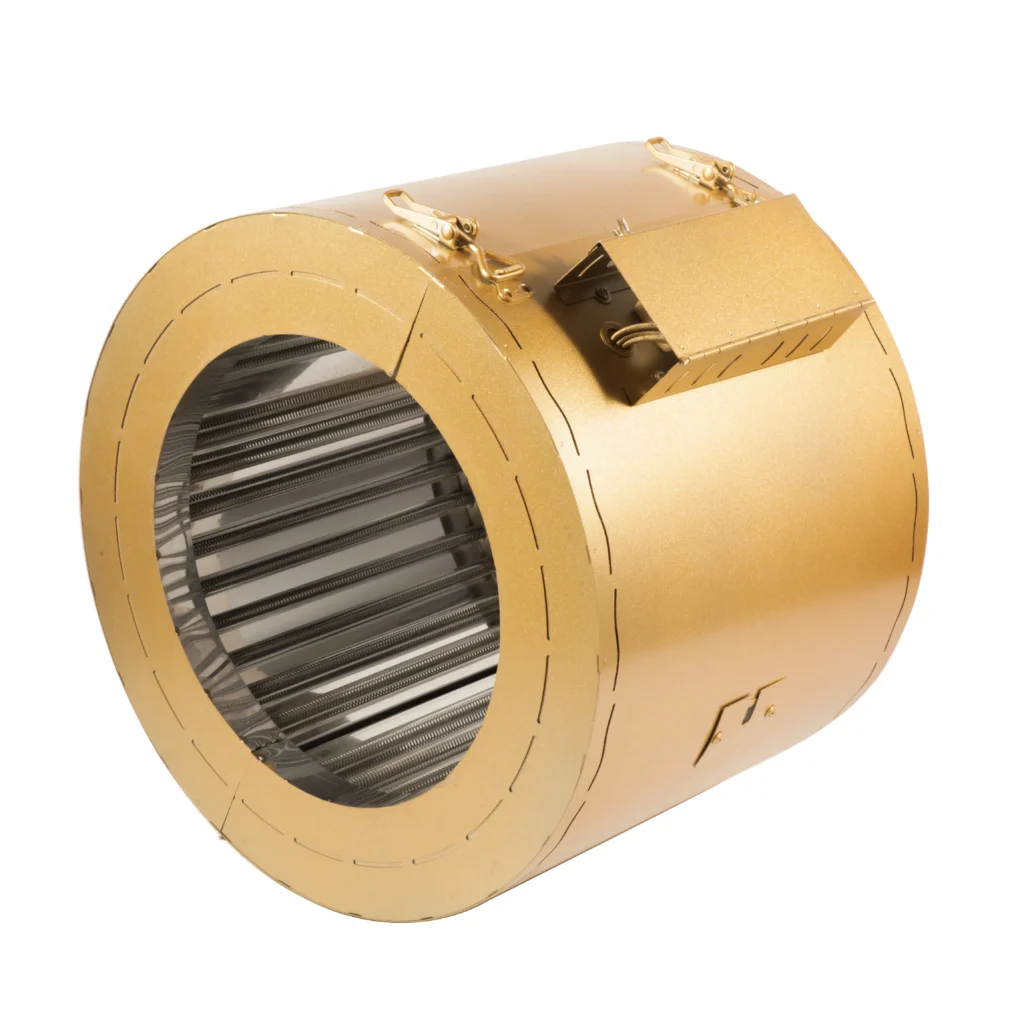
A professional industrial insulation sleeve is not a simple “wrap.” It is a multi-layered thermal engine designed to withstand the rigors of a 24/7 manufacturing environment.
Multi-Layer Construction
- Outer Layer (The Shield): Typically made of silicone-coated fiberglass. This layer is engineered to be chemical-resistant, moisture-proof, and easy to wipe clean of plastic splatter.
- Core Insulation (The Barrier): A high-density silica or ceramic fiber matting. This is the “aerospace-grade” engine of the sleeve, possessing extremely low thermal conductivity.
- Inner Layer (The Contact): A high-temperature stainless steel or fiberglass mesh that directly contacts the hot heater sheath without degrading.
Fastening Systems for Frequent Maintenance
Maintenance-friendly designs are paramount. Custom sleeves utilize:
- High-Temp Velcro Straps: For rapid removal.
- D-Rings and Stainless Steel Springs: To ensure the sleeve stays snug even as the machine vibrates or undergoes thermal expansion.
- Drawstrings: To seal the edges and prevent “chimney effect” heat loss from the sides.
3. The Triple Benefit: Energy, Safety, and Precision
Investing in insulation sleeves satisfies three distinct stakeholders within a manufacturing organization.
1. Energy Savings (CFO Focus)
The most immediate impact is on the balance sheet. By reducing the heater’s duty cycle by 20-40%, the direct reduction in kWh consumption is massive. In high-cost electricity markets, the sleeves often pay for themselves through the utility bill alone in under a year.
2. Workplace Safety (EHS Focus)
Hardcore Safety Data: A bare metal heater at 300°C causes a third-degree burn in less than one second of accidental contact. An insulated sleeve drops that external surface temperature to a “Touch-Safe” range (typically 50°C to 65°C). This drastically reduces OSHA recordable incidents and eliminates the need for bulky, obstructive metal safety cages around the machine.
3. Thermal Stability (Engineer Focus)
Uninsulated heaters are vulnerable to “Cold Spots” caused by workshop drafts, ceiling fans, or open bay doors. These fluctuations confuse the PID controller and cause inconsistent melt temperatures. Insulation provides a stabilized thermal environment, ensuring that the polymer reaches the nozzle with perfect uniformity, thereby reducing part warping and visual defects.
4. HVAC Interaction: The Hidden Saving
The most frequently overlooked factor in ROI calculations is the “Double Dip” saving related to the factory’s cooling load.
Reducing the Shop Floor Ambient Load
Every kilowatt of heat that escapes your extruder must be removed by your factory’s HVAC or industrial chilling system to maintain a tolerable working temperature for staff and electronics.
The 3:1 Rule: For every 1kW of radiant heat successfully blocked by an insulation sleeve, your factory’s air conditioning system saves approximately 0.3kW to 0.4kW of cooling energy. When you multiply this across 20 machines and 300 working days, the secondary energy savings are often enough to justify the upgrade on their own.
5. Custom Fitment: Holes, Cut-outs, and Thermocouples
The primary challenge in fitting a bulky sleeve is the complexity of modern machinery. A poorly fitted sleeve that covers a terminal box or pinches a wire is a fire hazard.
Engineering for Obstructions
Custom sleeves must be designed with precision cut-outs for:
- Terminal Boxes: To allow for electrical inspection.
- Thermocouple Probes: To ensure the sensor remains in contact with the barrel.
- Clamping Bolts: To allow for periodic re-torquing.
Pro Tip: Always allow at least a 1-inch (25mm) clearance around electrical wiring exits. Over-insulating the electrical terminals can cause the “Cold Pins” to overheat, leading to lead-wire embrittlement and premature electrical failure.
6. ROI Calculation: When does it pay for itself?
Based on data from Hongtai (ht-heater.com) field audits, the financial case for insulation sleeves is compelling.
| Factor | Impact / Savings Potential |
|---|---|
| Direct Electricity Saving | 20% – 45% reduction in heater power draw |
| HVAC Cooling Reduction | 10% – 15% reduction in facility cooling costs |
| Heater Lifespan Increase | ~15% increase due to reduced thermal stress on wire |
| Typical Payback Period | 4 – 9 Months |
7. Professional Recommendation: Retrofit vs. New Install
When planning your thermal strategy, consider the following:
- For New Machinery: Specify [Ceramic Band Heaters] as your baseline, as they offer better inherent insulation than mica.
- For Existing Infrastructure: Retrofitting with external insulation sleeves is the most cost-effective way to transform an “energy-hungry” legacy machine into a high-efficiency production unit without replacing the heaters themselves.
Frequently Asked Questions
Will an insulation sleeve cause my band heater to burn out faster?
No, provided the sleeve is professionally engineered. A high-quality sleeve reflects heat back toward the barrel, allowing the heater to reach the setpoint faster and remain in “idle” or “low-power” mode for longer periods. This actually extends the heater’s life by reducing the total cumulative time the internal resistance wire is under full electrical load.
Can these sleeves be reused after I replace a heater?
Yes. Unlike “wrap-on” insulation tape, professional industrial sleeves are designed with Velcro or D-ring fasteners specifically for reusability. They can be removed and re-installed hundreds of times, making them a long-term capital investment that outlasts the individual heating elements they protect.
How do I know what size insulation sleeve to order?
You must provide the Outer Diameter (OD) of the heater after it is installed on the machine, the width of the heater, and the exact locations of the electrical terminals. The sleeve is manufactured with a slightly larger ID to wrap perfectly over the heater without leaving gaps.
Are these sleeves fireproof?
Yes. Industrial-grade insulation sleeves are manufactured from non-combustible materials such as silicone-coated fiberglass and ceramic fiber. They are engineered to withstand continuous exposure to temperatures up to 500°C–600°C, meeting strict factory safety and fire compliance standards.