In the high-speed blow molding of PET bottles, PE packaging containers, and industrial drums, cycle times are not measured in minutes; they are measured in seconds. As cold polymer resin is rapidly and continuously pushed through the extruder and die head, it violently strips thermal energy away from the steel barrel.
If the installed heating element cannot instantly recover this depleted energy, the extruded plastic tube—the parison—will suffer from viscosity shifts. These microscopic changes in polymer flow dictate the entire structural integrity of the final product, leading to uneven wall thickness, warped containers, burst bottles during pressure testing, and massive volumetric scrap rates.
This engineering guide deconstructs the thermodynamics of high-speed plastic extrusion and blow molding. We will analyze why “thermal mass” is the enemy of cycle time and demonstrate how specifying low-inertia heating elements can lock in your parison dimensions perfectly, shot after shot.
The engineering reality is this: High-cycle packaging machinery requires heaters with rapid heat-up and immediate cool-down capabilities. Heavy, insulated heaters designed for sustained heat cause destructive thermal overshoot in these dynamic applications. Upgrading to ultra-thin Mica Band Heaters or instant-response Nano Infrared Heaters provides the thermodynamic agility required to match millisecond PID controller commands.
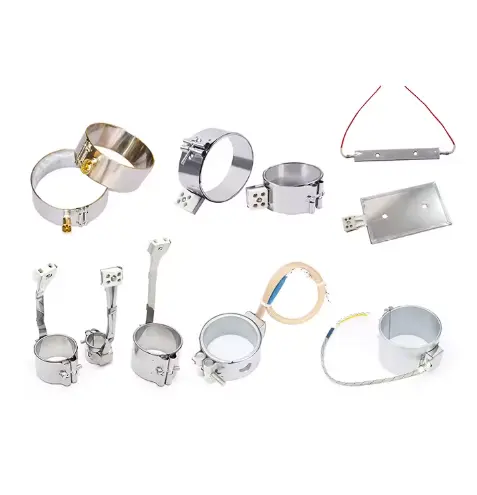
To understand the exact physical and material differences between low-mass and high-mass heaters before specifying your line, refer to our [Ceramic vs. Mica Band Heater Guide].
1. The Physics of Blow Molding: Continuous Heat Depletion
To specify the correct thermal component, engineers must first understand why standard injection molding heaters frequently fail when applied to blow molding or continuous extrusion packaging applications.
The Parison Viscosity Challenge
In blow molding, the parison is suspended in open air before the mold halves clamp shut. During this critical split-second, the polymer’s “melt strength” and viscosity ($\eta$) must remain in absolute equilibrium.
Polymer melt viscosity is exponentially dependent on temperature. If the die head temperature drops by just $2^\circ C$ during a high-speed continuous cycle, the viscosity of the polymer increases locally. As high-pressure air is injected to blow the parison against the mold walls, this cooler, more viscous section of the plastic will not stretch at the same ratio as the warmer sections.
The physical result is a container with uneven wall distribution—a thick, heavy bottom and a paper-thin, fragile side wall. In beverage packaging, this compromises the burst-pressure rating of the bottle; in industrial chemical packaging, it results in catastrophic drop-test failures.
Thermal Inertia vs. Cycle Time
Thermal inertia dictates how quickly a material can change its temperature. It is a function of the heater’s physical mass ($m$) and its specific heat capacity ($c_p$).
If you install a heavy-duty heater with massive thermal inertia on a blow molding die, it may take 5 minutes to reach the setpoint and 10 minutes to cool down. It is physically impossible for a component with a 10-minute reaction time to effectively control a thermodynamic process that cycles every 4 seconds. The heater will continuously lag behind the machine’s actual thermal requirements.
2. Eradicating Thermal Lag: The Low-Mass Solution
Selecting the right insulation material for a blow molding application requires prioritizing agility over maximum sustained temperature limits.
Why Heavy Ceramic Fails Here
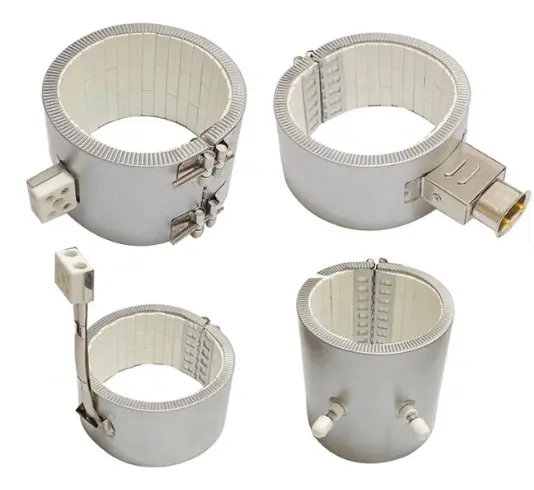
Ceramic Band Heaters are the undisputed standard for high-temperature engineering plastics and large, steady-state injection molding barrels. However, in high-speed blow molding, their greatest strength—their thick, insulating steatite ceramic tiles—becomes a critical liability.
Ceramic tiles store massive amounts of residual heat. When the PID controller detects that the die head has reached the target temperature, it commands the Solid State Relay (SSR) to cut the electrical power. However, the heavy ceramic continues to radiate its stored heat into the die head for several minutes. This creates “thermal overshoot.” The die becomes too hot, the parison becomes too fluid (runny), and the plastic sags under its own weight before the mold can close, destroying the parison programming.
The Advantage of Ultra-Thin Mica
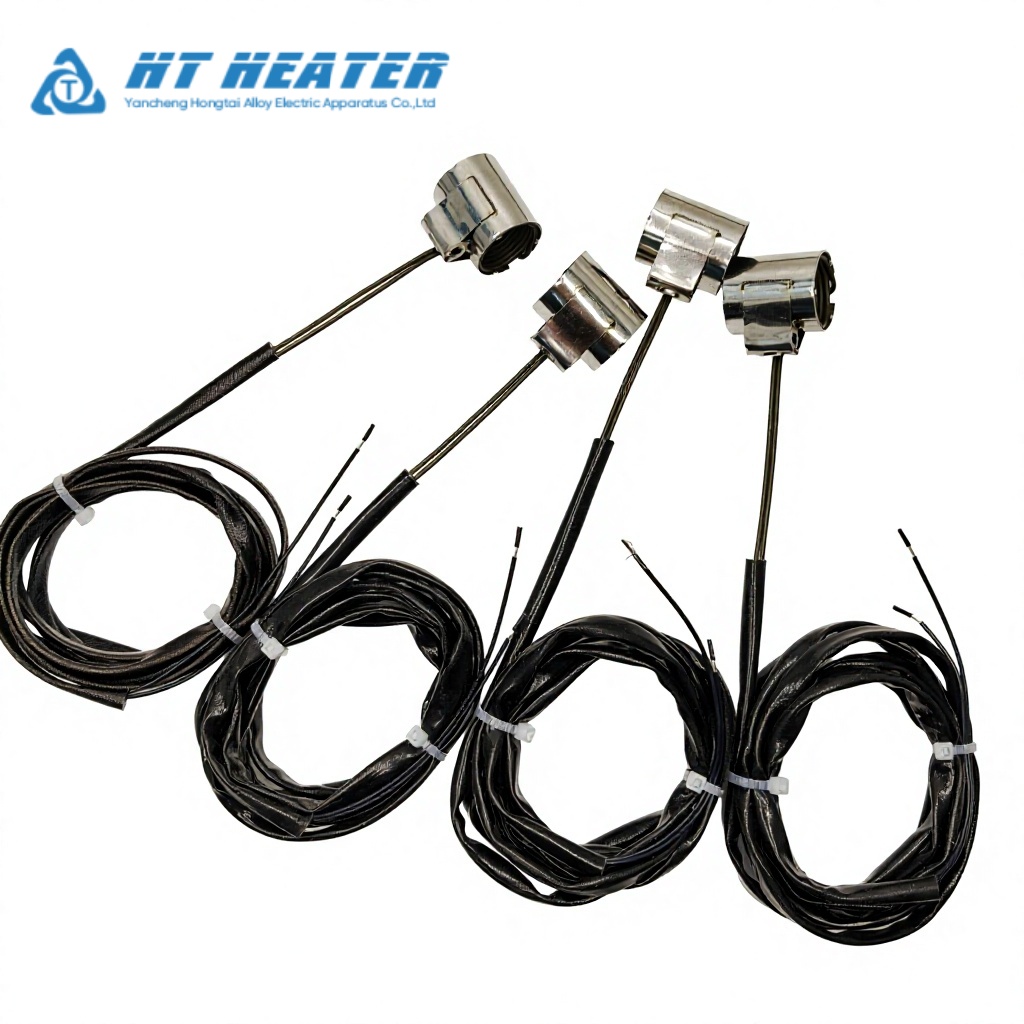
To achieve thermal agility, mass must be eliminated. Mica Band Heaters are constructed with a minimal-thickness profile, utilizing only a thin NiCr resistance ribbon sandwiched between phlogopite mica dielectric sheets, encased in a thin stainless steel sheath.
Because a mica heater lacks physical mass, it transfers its generated heat instantly into the barrel via direct conduction. More importantly, the millisecond the SSR shuts off the power, the mica heater stops transferring heat. This “stop-on-a-dime” capability prevents thermal overshoot, ensuring the parison maintains the exact melt strength required for uniform stretching.
3. Nano Infrared Technology: The Ultimate Cycle-Time Optimizer
For facilities that require rapid thermal response but cannot afford the massive ambient energy losses associated with uninsulated mica heaters, advanced radiant physics provides the ultimate solution.
Instant Radiant Heat and Zero Overshoot
Nano Band Heaters bypass the limitations of standard conduction. Instead of relying on physical mass to push heat into the barrel, the internal nano-coating generates high-frequency far-infrared radiation.
These electromagnetic infrared waves penetrate the steel die head directly, heating the polymer without the phase delay of conduction. The heater itself contains an aerospace-grade aerogel insulation layer that is incredibly light, giving the entire unit virtually zero thermal mass. When the controller demands heat, the infrared emission is instantaneous; when the setpoint is reached, the emission ceases instantly. This allows for a perfectly flat thermal profile even at maximum extrusion speeds.
ROI in High-Volume Packaging
Blow molding and packaging lines run 24/7 at exceptionally high throughput. Energy consumption is a massive line item on the facility’s balance sheet.
Because Nano heaters utilize aerogel to trap infrared energy, they do not bleed radiant heat into the factory environment. This results in direct electrical savings of 30% to 50% on the heating circuit. In high-volume continuous packaging applications, this reduction in kW/h yields an exceptionally fast payback period, frequently offsetting the initial capital expenditure of the Nano heaters in under 5 months.
4. Hardware for Large Die Heads: Clamping and Fitment
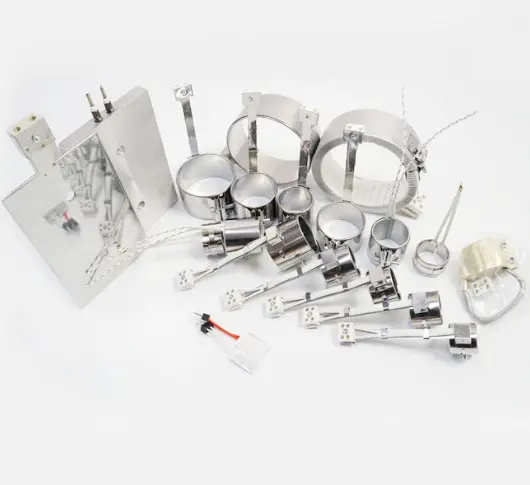
Blow molding isn’t limited to 500ml water bottles. Manufacturing 5-gallon water jugs, automotive fuel tanks, or 55-gallon industrial chemical drums requires massive accumulator die heads. Securing thermal components to these massive steel blocks presents severe mechanical challenges.
Two-Piece and Multi-Segment Designs
Installing a standard, single-piece band heater over a 20-inch diameter accumulator head is physically impossible without permanently distorting the heater’s metal sheath.
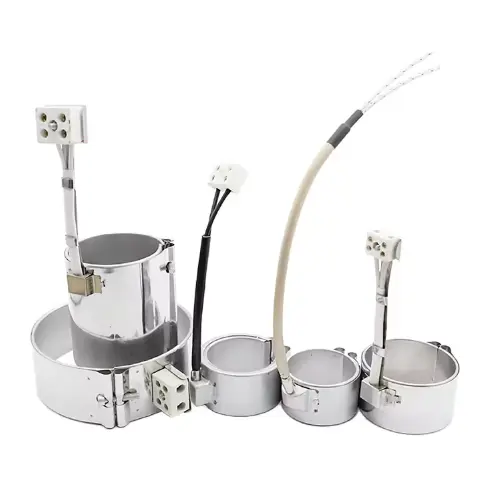
For large-diameter blow molding machinery, engineers must specify Two-Piece or Multi-Segment band heaters. These modular designs allow maintenance teams to bolt the heater halves together directly on the machine, ensuring a flush fit without risking damage to the internal resistance wire during installation.
Spring-Loaded Expansion Compensation
The coefficient of thermal expansion ($\alpha$) dictates that a massive steel accumulator head will grow significantly in circumference as it heats from 20°C to 250°C.
If a technician tightens a large-diameter heater using standard flange lock-ups while the machine is cold, the immense outward pressure of the expanding die head will snap the clamping bolts or permanently stretch the heater casing.
To counteract this, Spring-Loaded Barrel Nuts are mandatory on large blow molding die heads. These heavy-duty die springs actively compress to absorb the thermal expansion, ensuring the heater maintains 100% flush contact with the die head without breaking, and automatically retracting when the machine cools down.
5. Maximizing Uptime: Quick-Change Terminations
In the packaging industry, Mean Time To Repair (MTTR) is a critical Key Performance Indicator (KPI). When a heater inevitably reaches its end of life, the speed at which it can be replaced dictates the profitability of the shift.
The Cost of Wiring Downtime
In a high-speed bottling plant capable of producing 20,000 bottles per hour, a 30-minute maintenance delay equates to 10,000 lost units of production.
Standard band heaters utilize threaded post terminals or bare lead wires that must be hard-wired into a junction box. This requires a licensed technician to lock out the machine, strip wire insulation, crimp new ring terminals, and torque nuts—a process that easily consumes 20 to 30 minutes per heating zone.
European-Style Plugs for Instant Swaps
To minimize MTTR, process engineers should specify blow molding heaters with high-temperature European-style quick-disconnect plugs.
These plug-and-play interfaces feature a rugged, grounded aluminum housing with a high-temperature ceramic insert. If a heater fails, a machine operator or technician can safely unplug the power cable, swap the physical heater band, and plug the power back in under 60 seconds, drastically reducing machine downtime and eliminating the risk of miswiring the zone.
6. Specification Matrix for Packaging Extrusion
To ensure maximum yield and minimum downtime, align your specific packaging process with the correct heater architecture using the following decision matrix.
| Packaging Application | Process Challenge | Recommended Heater Configuration |
|---|---|---|
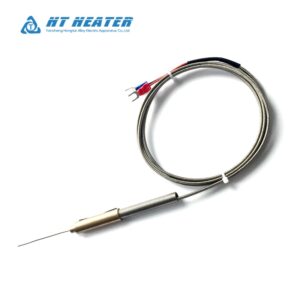
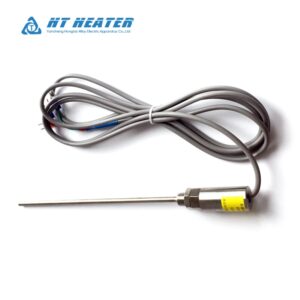
| High-Speed PET Bottles | Rapid heat depletion from high velocity resin; strict parison viscosity control required. | Thin-profile Mica Band Heater with built-in J-type thermocouple for millisecond feedback. |
| Large Industrial Drums | Massive dimensional thermal expansion on large accumulator die heads. | Two-Piece Mica design equipped with Spring-Loaded fasteners. |
| 24/7 Food Packaging | High ambient energy costs and strict temperature stability requirements. | Nano Infrared Heater for up to 30% energy reduction and flat, zero-overshoot PID response. |
| Extrusion Wash-Down Zones | Strict water and chemical cleaning protocols causing electrical shorts. | Sealed Terminal Boxes (IP65) with Teflon-insulated lead wires. |
7. Blow Molding Maintenance SOP: Calibration and Contact
Precision thermal control requires a pristine mechanical interface. Incorporate these procedures into your facility’s Total Productive Maintenance (TPM) schedule.
Cleaning the Die Head
Blow molding heads frequently suffer from “drool” (molten polymer escaping the die lips and traveling up the exterior of the tooling). If a new heater is installed over this hardened plastic, an insulating air gap forms, immediately causing the heater to burn out.
- SOP: Before installing any replacement heater, the die head must be aggressively cleaned with a brass scraper or wire wheel until bare metal is exposed. 100% flush contact is the only way a low-mass heater can effectively transfer its energy.
SSR and PID Verification
Low-mass heaters are highly reactive. If the machine’s Solid State Relay (SSR) fails in the “closed” (shorted) position, it will deliver continuous, unmodulated voltage to the heater.
Because mica and nano heaters lack the thermal mass to absorb this runaway energy safely, a stuck relay will cause an instantaneous and catastrophic temperature spike, melting the internal wire and potentially degrading the polymer into a volatile gas.
- SOP: Maintenance technicians must use a multimeter to verify that all SSRs are actively pulsing (opening and closing) according to the PID command signal during monthly audits.
Frequently Asked Questions
Why does my blow molding parison have uneven wall thickness?
Uneven wall thickness is frequently caused by temperature variations across the die head. If your band heater has poor surface contact or possesses too much thermal mass to recover heat fast enough during the extrusion cycle, the plastic’s viscosity changes locally. This leads to uneven stretching during the blow phase, resulting in thin or warped sections in the final container.
Are ceramic band heaters good for blow molding?
Generally, no. While ceramic heaters are excellent for steady-state, high-temperature injection molding applications, they possess high “thermal mass.” They retain heavy amounts of heat and respond slowly to PID controller adjustments. This causes temperature overshoots that make the parison sag, disrupting the fast cycle times required in blow molding.
How can I speed up heater replacement on my high-speed packaging line?
The most effective way to reduce replacement downtime (MTTR) is to specify your custom band heaters with European-style quick-disconnect plugs. This eliminates the need for technicians to strip wires, manipulate small terminal screws, or use a multimeter to verify polarity, reducing a 20-minute wiring job to less than 60 seconds.
What is the best heater for a very large accumulator die head?
For large diameter die heads (e.g., those used for molding 55-gallon drums or automotive fuel tanks), you should specify a Two-Piece Mica Band Heater equipped with Spring-Loaded Clamping. The two-piece design allows for installation without bending the heater, while the springs automatically expand and contract to absorb the massive physical thermal expansion of the large metal die head without snapping the bolts.