Processing recycled plastic is fundamentally different from processing virgin resin. In the 2026 circular economy, Post-Consumer Resin (PCR) and Post-Industrial Resin (PIR) have become the primary feedstocks for sustainable manufacturing. However, recycled feedstock is “wild”—it contains residual moisture, trace oils, and inconsistent polymer blends that lead to unpredictable melting points and volatile viscosities.
In these harsh environments, standard band heaters do not just fail; they fail catastrophically. Contamination ingress from labels or oils and the extreme thermal demands of processing degraded polymers create a “perfect storm” for electrical breakdown. For a recycling facility, “Heavy-Duty” is not a marketing term; it is a technical requirement for survival.
This guide addresses the mechanical and thermal challenges inherent in the recycling industry. We will discuss the physics of contaminated melt, why superior sealing is a prerequisite for uptime, and how to specify heating systems that can withstand the chemical and physical abuse of a 24/7 recycling line.
The engineering BLUF (Bottom Line Up Front) is this: Recycled materials often require higher watt densities and hermetic sealing to overcome inconsistent viscosities and fluid contamination. Upgrading to Sealed Brass or Reinforced Ceramic heaters can reduce maintenance-related downtime by over 60% in recycling applications.
If your recycling line is struggling with frequent burnouts, start with our [Band Heater Troubleshooting Guide] to identify the root cause.
1. The “Wild” Variable: Why Recycled Pellets Are Harder to Heat
In virgin plastic extrusion, the resin is a known constant. In recycling, the feedstock is a variable. Understanding the material science of degraded polymers is the first step in engineering a stable thermal zone.
Inconsistent Melting Points and Viscosity Spikes
Recycled plastic is rarely a pure polymer. Even with advanced sorting, a batch of HDPE flakes may contain trace amounts of PP or PET. These polymers have different melting points and “heat of fusion” requirements.
When a “pocket” of high-melt-point plastic enters the screw, the torque increases and the temperature drops. This requires the band heater to output a sudden “burst” of energy to maintain the setpoint. A heater with low thermal response or inadequate watt density will fail to stabilize the melt, leading to “unmelted” contaminants that can damage the screen pack or the die.
The Moisture/Steam Factor
Despite rigorous drying, recycled flakes often retain microscopic levels of internal moisture. When this material enters the transition zone of the extruder at 200°C+, the moisture turns into high-pressure steam. The Engineering Risk: If your band heaters are not properly sealed, this steam can penetrate the seams of the heater sheath. Once moisture enters the mica or ceramic core, it lowers the insulation resistance (IR), leading to ground faults and immediate heater failure.
2. Fighting the “Killers”: Oil, Grease, and Chemical Residue
The recycling environment is “dirty” by definition. Residual adhesive from labels, fats from food packaging, and detergents create a chemically aggressive atmosphere.
The Capillary Effect of Contaminants
Standard mica band heaters are constructed with folded seams. These seams are susceptible to the capillary effect. Molten contaminants (oils and adhesives) are drawn into the heater’s interior.
Under the heat of the element, these fluids undergo Pyrolysis—they burn in an oxygen-deprived environment and turn into pure carbon. Carbon is highly conductive. This creates “conductive tracks” across the mica insulation, allowing the electrical current to arc from the resistance wire to the grounded sheath. This is the primary cause of “blown” heaters in recycling plants.
Solution: The Full-Encapsulation Strategy
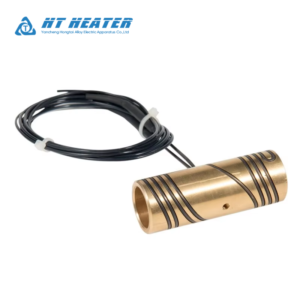
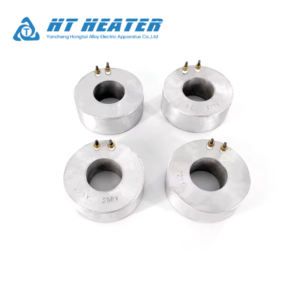
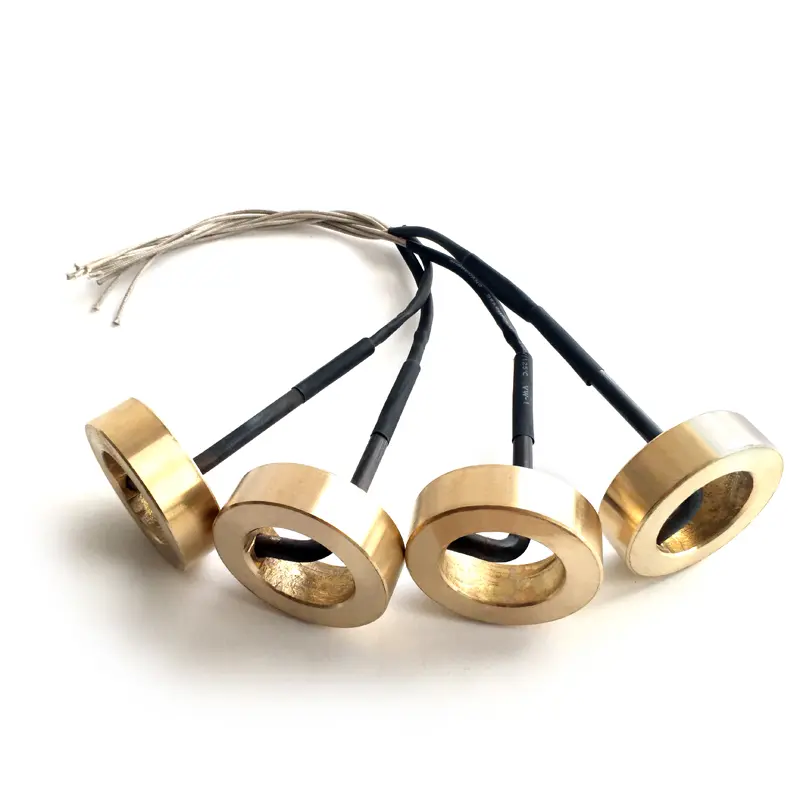
For recycling extruders, Brass Sealed Nozzle Heaters are the minimum standard. The hermetically folded brass sheath provides a physical barrier that is impervious to oil and liquid plastic.
For even harsher zones, engineers should specify Mineral Insulated (MI) Band Heaters. These use a tubular heating element compacted with magnesium oxide (MgO) within a seamless metal tube. This construction is physically impossible for oil or water to penetrate, making it the “Gold Standard” for high-contamination recycling lines.
3. High Thermal Demand: Processing PCR and Pyrolysis Feedstock
Recycled polymers have already undergone at least one heat cycle, which often degrades their molecular chain length. To achieve the required flow characteristics, these resins frequently require more aggressive heat profiles than their virgin counterparts.
Overcoming Polymer Degradation Heat Requirements
Degraded polymers often exhibit higher non-Newtonian viscosity at lower temperatures. To prevent “Melt Fracture” at the die, the barrel temperatures must be pushed higher.
Specifying the “Heavy Duty” Ceramic Band
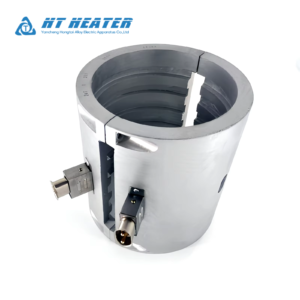
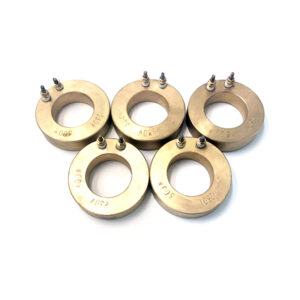
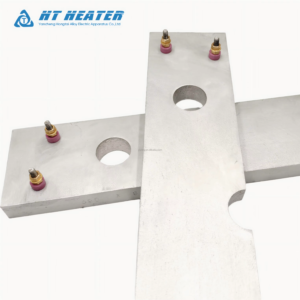
Standard mica heaters have a physical ceiling of 3 W/cm². Pushing them harder in a recycling context leads to binder volatilization. The Recommendation: Recycling lines should prioritize Ceramic Band Heaters with reinforced stainless steel jackets. These are rated for 6 W/cm² and can withstand continuous operating temperatures of 600°C. The interlocking ceramic knuckles provide a radiant heat component that is more effective at penetrating inconsistent, “thick” recycled melt than pure conduction.
4. Engineering for Abrasive Environments: Mechanical Protection
Recycling plants are high-traffic, industrial environments. Heaters are frequently subjected to physical impact from heavy tools, material bags, or maintenance during frequent screen pack changes.
Armored Termination Systems
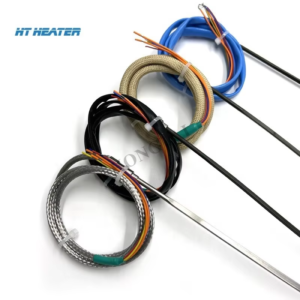
An exposed lead wire in a recycling plant is a liability. Vibration from large-scale grinders and shredders can cause standard fiberglass leads to chafe and short out.
- SOP: Mandatory use of Stainless Steel Armor Cable (Flexible Conduit) for all lead wires. The conduit should be securely anchored to a terminal box to ensure that no tension is ever applied to the internal heater connections.
5. Thermal Stability in Inconsistent Feed: Advanced Control
Inconsistent feedstock leads to “Thermal Surging.” If the heater cannot respond fast enough to a cold slug of material, the resulting pressure spike can trip the extruder’s motor drive.
Mitigating Temperature Swings with Nano Technology
Nano Band Heaters offer a unique advantage for recycling: Zero Thermal Inertia. Because they utilize far-infrared radiation rather than just conduction, they can penetrate the barrel and the melt more quickly. When the control system detects a temperature drop due to inconsistent feedstock, the Nano heater delivers energy almost instantly. Conversely, when the material passes, the heater stops emitting heat instantly, preventing the “overshoot” that can yellow or degrade recycled resins.
6. The ROI of Durability: Why “Cheap” Heaters Kill Recycling Profits
In the recycling industry, the profit margin is dictated by throughput. A “cheap” heater that saves $30 on procurement but causes 4 hours of downtime is a financial disaster.
| Challenge in Recycling | Recommended Heater Feature | Technical Reason |
|---|---|---|
| Oil/Fluid Leaks | Fully Sealed Brass | Prevents carbon tracking and internal arcing from oil ingress. |
| High Melt Temps | Insulated Ceramic | Safely handles 400°C+ without dielectric breakdown. |
| Mechanical Vibration | Spring-Loaded Clamping | Maintains constant barrel contact despite heavy plant vibration. |
| Inconsistent Feed | Nano-Infrared | Fastest thermal recovery time for “cold slugs” in the melt. |
7. Maintenance SOP for Recycling Plants: The “Weekly Scrape”
Preventative maintenance in a recycling plant must be more aggressive than in a virgin resin facility.
Preventing Carbon Buildup
“Melt-over” (where plastic overflows the nozzle or barrel) is common in recycling. If this plastic is not removed, it creates an insulating layer between the heater and the barrel.
- The SOP: Once per week, inspect the barrel for “plastic islands.” Use a non-marring brass brush to clean the barrel surface. This ensures that the 100% metal-to-metal contact required for heat transfer is maintained.
The Insulation Resistance (Megger) Test
Because of the high risk of moisture and oil ingress, recycling plants should perform quarterly Insulation Resistance (IR) testing.
- Action: Using a Megohmmeter, test each heater zone for leakage to ground. Any heater reading below 10 MΩ should be flagged for immediate replacement during the next scheduled shutdown. Catching a “leaky” heater before it blows the main breaker can save an entire shift’s production.
Frequently Asked Questions
Why do my band heaters burn out so quickly when processing recycled plastic?
The primary cause is contamination ingress. Recycled pellets often release oils, moisture, and chemical residues that seep into the seams of unsealed mica heaters. These fluids carbonize, creating conductive paths that cause internal short circuits. Upgrading to Sealed Brass or Mineral Insulated heaters is the standard engineering fix.
Do recycled plastics require higher temperatures than virgin plastics?
Often, yes. Recycled feedstock is usually a blend of different polymer grades. To ensure every component in the blend is fully molten and homogeneous, process temperatures must often be set higher. This requires Ceramic Band Heaters capable of higher watt densities and 600°C operation.
Can I use energy-saving nano heaters on a recycling extruder?
Absolutely. In fact, because recycling extruders often run 24/7 at high temperatures, the ROI for Nano Band Heaters is typically the fastest in the industry—often under 6 months. The reduction in radiant heat loss also significantly improves the working environment near the grinders and extruders.
How can I protect my heater wires from getting crushed in a recycling plant?
Always specify Stainless Steel Armor Cable (Hose). In the high-traffic, heavy-machinery environment of a recycling facility, exposed fiberglass wires are a major safety risk and a common cause of downtime. Armor cable provides the mechanical “armor” needed to survive accidental impacts.