In the automotive sector, the interior cabin represents the consumer’s primary tactile and visual interface with the brand’s quality. A single “silver streak,” a visible flow line, or localized variations in gloss on a center console, dashboard trim, or “Piano Black” door switch panel can lead to the rejection of entire batches by Tier-1 OEMs.
From an engineering perspective, these aesthetic failures are rarely the fault of the mold geometry itself. Instead, they are the byproduct of thermal instability within the injection barrel. When processing advanced engineering resins like PC/ABS blends or PMMA, a temperature deviation of even ±3℃ significantly alters the polymer’s viscosity, leading to hesitation marks and visible weld lines.
This guide analyzes the critical relationship between thermal uniformity and surface aesthetics in automotive molding. We will explore how high-precision Ceramic Band Heaters and Nano Infrared Technology provide the thermal stability required to meet the zero-defect mandates of the 2026 automotive supply chain.
The baseline engineering reality is this: High-gloss automotive parts require a thermal tolerance window of ±1℃ . Achieving this necessitates the elimination of “thermal lag” and ensuring 100% barrel contact to prevent the localized hot spots that cause resin degradation.
For a deep dive into the technical specifications of the heaters discussed here, visit our [Ceramic Band Heater Technical Hub].
1. The Aesthetic Challenge: Why Automotive Resins are Thermally Sensitive
Automotive interior components utilize sophisticated polymer blends designed for impact resistance, UV stability, and surface finish. However, these materials—specifically PC/ABS (Polycarbonate/Acrylonitrile Butadiene Styrene) and PMMA (Acrylic)—possess narrow processing windows.
Processing Engineering Plastics (PC/ABS & PEEK)
Resins like PC/ABS are non-Newtonian fluids; their viscosity is highly dependent on both shear rate and temperature. If the barrel temperature drops slightly below the glass transition point (Tg) during the injection phase, the melt viscosity spikes. This results in “hesitation marks”—minute ripples on the part surface where the plastic cooled prematurely against the mold wall.
The “Piano Black” Finish Crisis
The current automotive trend toward “Piano Black” (high-gloss black) finishes is particularly unforgiving. Unlike textured or matte surfaces, a glossy finish magnifies every internal contaminant. If a band heater has “hot spots” due to poor clamping or excessive watt density, the resin in contact with the barrel wall can locally degrade. This carbonization creates microscopic “black specks” that appear as permanent flaws in the glossy finish, leading to immediate part rejection.
2. Eliminating Flow Lines and Weld Lines with Uniform Heat
Visible flow lines and weld lines occur when two melt fronts fail to merge seamlessly. This is almost always a function of heat loss within the barrel or nozzle.
Physics: The Temperature Gradient Problem
In a standard band heater, the “Cold Zone”—the area at the clamping gap where no resistance wire exists—can create a temperature drop of up to $10^\circ C$ across that specific segment of the barrel. In automotive molding, this gradient creates a “cool streak” in the melt.
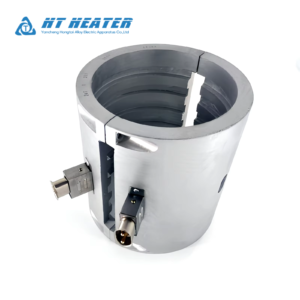
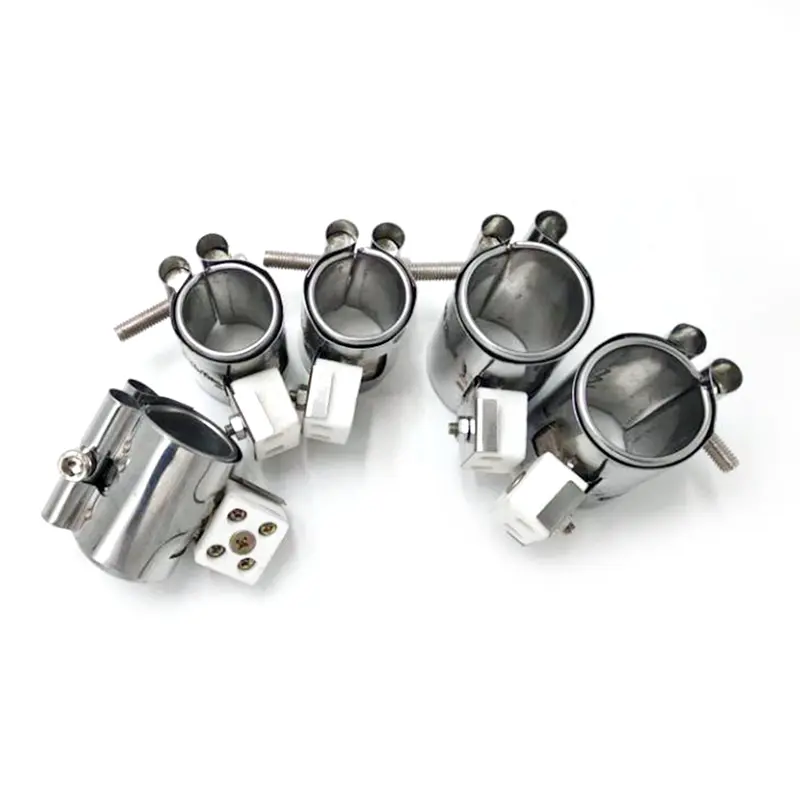
To solve this, Hongtai specifies Ceramic Band Heaters with a maximum watt density of 6 W/cm². The interlocking steatite ceramic knuckles provide a more uniform radiant heat distribution than mica, effectively bridging the gap at the clamping junction. By ensuring the melt is thermally homogeneous before it enters the mold, we eliminate the viscosity differentials that manifest as flow lines.
Thermal Stability vs. Cycle Time
Automotive production relies on high-speed cycles. However, rapid heating often leads to “thermal overshoot,” where the heater’s mass carries the temperature past the setpoint.
Nano Band Heaters solve this through zero thermal inertia. Utilizing far-infrared radiation and aerospace-grade aerogel insulation, they reach the setpoint faster than traditional bands but stop emitting heat the millisecond the PID controller cuts power. This allows for faster cycles without the risk of degrading heat-sensitive automotive resins.
3. The Nozzle Connection: Preventing “Drooling” and “Cold Slugs”
The transition from the barrel to the mold—the nozzle—is the most thermally volatile zone in the machine.
The Role of Sealed Brass Heaters
Automotive molds often utilize high-pressure, high-velocity injection to fill thin-walled components. This pressure frequently leads to nozzle leakage or “blowback.” If leaked resin seeps into a standard heater, it carbonizes and causes a short circuit. More importantly, the resulting temperature drop creates “cold slugs”—semi-solidified bits of plastic that enter the mold and create structural and visual defects.
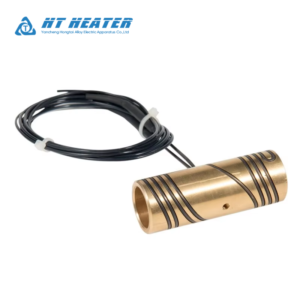
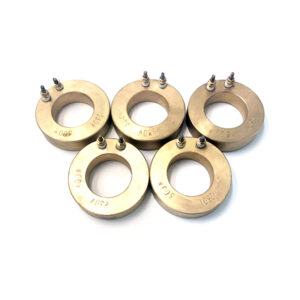
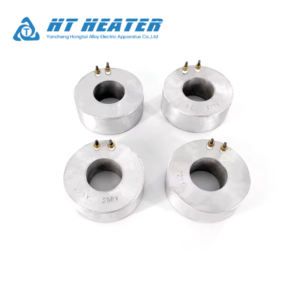
For these zones, we mandate Brass Sealed Nozzle Heaters. With a watt density of 5 W/cm² and a hermetically sealed brass sheath, these heaters are 100% leak-proof. They maintain the precise nozzle temperature required to prevent “drooling” (excess plastic leaking into the mold) while ensuring no cold slugs compromise the part’s high-gloss surface.
4. Advanced Control: Built-in Thermocouples for Real-Time Feedback
In automotive manufacturing, “Thermal Lag” is the enemy of quality. Thermal lag is the time delay between the heater turning on and the sensor detecting the temperature rise.
Integrated Sensing Logic
Most legacy machines use barrel-mounted thermocouples. However, for precision automotive molding, we recommend heaters with built-in J-type thermocouples.
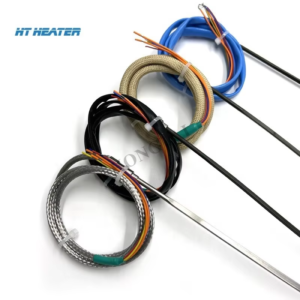
By placing the sensor directly inside the ceramic or brass heater structure, the distance between the heat source and the sensor is reduced to millimeters. This allows the PID controller to adjust in real-time to factory drafts or cooling fluctuations, maintaining the ±1℃ tolerance required for zero-defect high-gloss production.
5. Case Study: Reducing Rejection Rates in Center Console Production
The Scenario: A Tier-1 automotive supplier was experiencing a 15% rejection rate on a PC/ABS center console trim due to “silver streaks” and inconsistent gloss levels.
The Audit: Forensic analysis of the failed parts indicated localized resin degradation. Inspection of the machine revealed mica band heaters with visible air gaps and inconsistent clamping tension.
The Implementation:
- Replaced all barrel mica bands with Insulated Ceramic Band Heaters (6 W/cm²).
- Upgraded nozzle heaters to Brass Sealed units with integrated thermocouples.
- Applied a “Hot-Torque” SOP to ensure zero air gaps during thermal expansion.
The Result:
- Rejection Rate: Dropped from 15% to < 2%.
- Cycle Time: Reduced by 3.5 seconds due to the heaters’ faster thermal recovery and the elimination of the need for “soak time” to stabilize temperatures.
- Annual Savings: Estimated at $42,000 in reduced scrap and energy efficiency gains.
6. Automotive Maintenance SOP: Zero-Contamination Protocol
To maintain high-aesthetic standards, the maintenance routine must be as precise as the molding process itself.
| Step | Action for Automotive Excellence |
|---|---|
| 1. Barrel Prep | Use a non-marring brass brush to clean the barrel to bare metal. Any residue creates an air gap and a localized hot spot. |
| 2. Clamping | Use “Spring-Loaded” barrel nuts. These automatically compensate for thermal expansion, maintaining the 100% contact required for gloss consistency. |
| 3. Insulation | Add [Thermal Jackets] to every zone. This prevents factory floor drafts (fans/open doors) from causing $3^\circ C$ fluctuations that lead to flow lines. |
| 4. Verification | Perform quarterly Ohm-value checks. A change in resistance indicates thinning wire, which leads to uneven heating and surface defects. |
7. Conclusion: Investing in Aesthetics
In automotive manufacturing, the most expensive band heater is not the one with the highest purchase price; it is the $20 commodity heater that causes a $50,000 shipment of parts to be rejected by the OEM.
High-precision heating is an insurance policy for your facility’s reputation. By specifying heaters designed for thermal uniformity and rapid PID response, you eliminate the root causes of flow lines, splay, and inconsistent gloss. For Tier-1 suppliers, this transition from “commodity parts” to “engineered thermal solutions” is the key to maintaining a competitive edge in the 2026 automotive market.
Frequently Asked Questions
What causes silver streaks (splay) in high-gloss automotive parts?
Silver streaks are often caused by either moisture in the resin or, more commonly, by localized overheating in the barrel. If your band heaters have “hot spots” due to poor clamping, they can locally degrade the PC/ABS blend, releasing gas that appears as streaks on the finished part surface.
Why are ceramic heaters preferred for automotive interior molding?
Ceramic Band Heaters provide superior thermal insulation and more uniform radiant heat distribution than mica. This stability is critical for automotive resins that have a very narrow temperature window for achieving a perfect gloss finish without hesitation marks.
Can better band heaters really reduce my molding cycle time?
Yes. Heaters with 100% contact and aerospace-grade insulation reach the setpoint faster and recover more quickly after each injection shot. This improved “thermal responsiveness” allows you to reduce cycle times while maintaining the aesthetic integrity of the part.
How do I prevent nozzle leaks from destroying my automotive heaters?
We highly recommend upgrading to Brass Sealed Nozzle Heaters. These are hermetically encapsulated and 100% leak-proof. Even if high-pressure resin overflows at the nozzle, it cannot penetrate the heater, preventing short circuits and quality-destroying temperature drops.