Introduction
Why is your industrial oven set to 200°C, yet your coating remains wet near the substrate? Why does the surface of your plastic sheet blister before the core is soft?
The answer usually isn’t a lack of power; it’s a lack of absorption. You are likely using short-wave halogen lamps that shoot energy straight through your material, or convection heat that wastes energy heating the air. To fix this, you need to stop heating the environment and start heating the molecules.
What is a Carbon Fiber Quartz Heater?
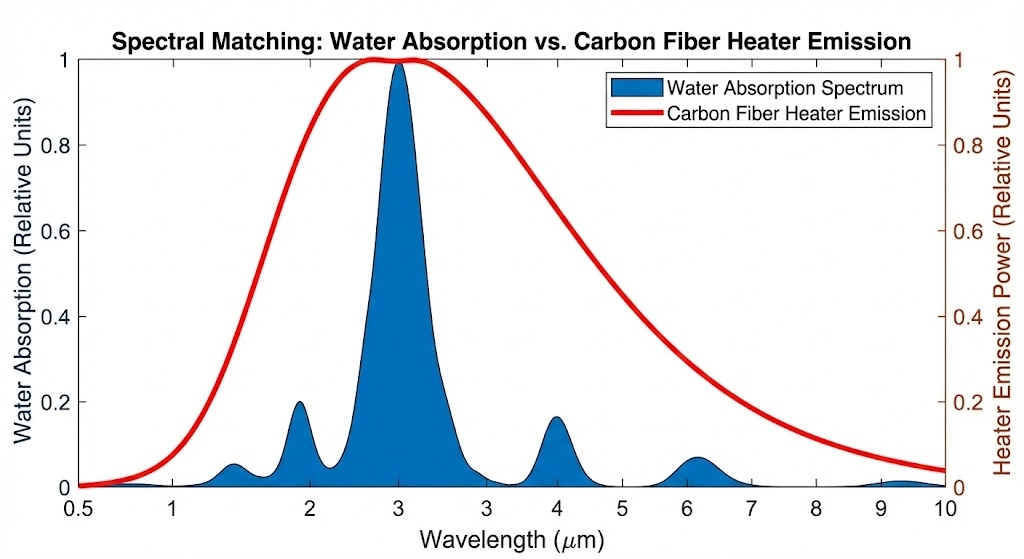
It is a medium-wave infrared emitter utilizing a woven carbon fiber filament sealed in a quartz tube. Operating at a peak wavelength of 2.0–4.0μm and a color temperature of approximately 1200K, these elements are engineered to match the natural absorption frequency of water molecules, solvents, and polymeric chains.
Engineering Context: While halogen emitters dominate high-speed applications due to their instant response, they often overheat surfaces in drying processes. As detailed in our , selecting the right wavelength is critical. For drying water and curing plastics, Carbon Fiber is the superior choice.
Absorption Spectrum Matching: Why 2.5-3.5μm is the “Golden Band”
1. Water & Polymer Resonance
The physics of drying is defined by Resonance. Every material vibrates at a specific frequency. When the frequency of your heat source matches the vibration of the target molecule, energy transfer is nearly 100% efficient.
- Water (H₂O): Has a massive absorption peak between 2.5μm and 3.0μm.
- Plastics (C-H Bonds): Polyethylene (PE), Polypropylene (PP), and PVC absorb infrared energy most efficiently between 3.0μm and 3.5μm.
If you use a Halogen Short-Wave lamp (1.0μm), the radiation passes through the clear water or plastic like light through a window. It hits the metal machine bed below, heats the metal, and eventually heats the product via conduction. This is slow and wasteful.
Carbon Fiber Medium-Wave emitters (2.0–4.0μm) hit the “Golden Band” exactly. The energy is grabbed immediately by the water or plastic molecules, vibrating them instantly to generate heat from within.
Technical Advantages: Soft Heat & Electrical Stability
1. Zero Inrush Current
For electrical engineers, this is the defining feature of Carbon Fiber compared to Tungsten/Halogen.
- Halogen: Cold tungsten has near-zero resistance. Startup current spikes to 15x nominal, requiring expensive SCR power controllers to prevent breaker trips.
- Carbon Fiber: Carbon has a negative temperature coefficient, but its resistance remains relatively stable during startup.
- The Benefit: You do not need complex Soft-Start SCRs. Standard contactors or simple solid-state relays (SSRs) are sufficient. This drastically reduces control panel costs and grid stress.
2. Extended Lifespan (>6000 Hours)
Because the carbon filament is sealed in a vacuum or inert gas environment, it does not oxidize. Unlike tungsten, which becomes brittle and recrystallizes over time, carbon fiber maintains its mechanical integrity.
- Rated Life: Typically 6000–8000 Hours (depending on application).
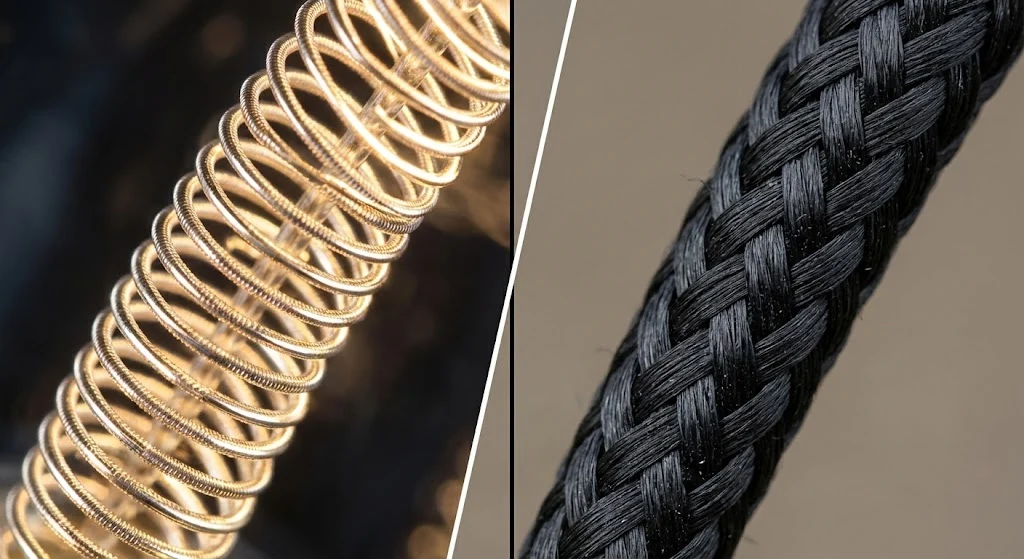
- Durability: The woven structure is less susceptible to vibration damage than a coiled tungsten wire.
Best Use Cases: Where Carbon Fiber Wins
1. Powder Coating & Paint Curing
The Problem with Convection: Blowing hot air moves dust onto the wet paint.
The Problem with Short-Wave: It heats the surface too fast, creating a “skin.” Solvents trapped underneath boil and burst through the skin, causing “Solvent Pop” (pinholes).
The Carbon Solution: Medium-wave energy penetrates the wet coating just enough to heat the substrate and the coating simultaneously. This drives solvents out from the bottom up, ensuring a smooth, defect-free finish.
2. Vacuum Forming & Thermoforming
The Problem: In a mixed production run, black plastic absorbs heat fast, while white plastic reflects it.
The Carbon Solution: Medium-wave radiation is less “color sensitive” than short-wave light. Carbon fiber heaters provide Uniform Thermal Distribution across different colored plastic sheets, reducing the need to adjust controller settings for every color change.
3. Outdoor & Commercial Heating
The Problem: High-glare halogen lamps are uncomfortable for human eyes in patios or saunas.
The Carbon Solution: Carbon fiber emits a soft, warm orange glow (Low Glare). It heats human skin efficiently (as we are mostly water) without the blinding light.
Selection Guide: Customizing Your Emitter
1. Geometry & Installation
Carbon Fiber filaments are mechanically robust. Unlike halogen tungsten wires which sag and short-out if mounted vertically (unless specially supported), Carbon Fiber tubes have a Universal Burning Position.
- Orientation: Horizontal, Vertical, or Angled.
- Shapes: Straight, U-Shape, Pear-Shape, and Omega (Ω) Round.
2. Reflector Technology: The Ceramic Advantage
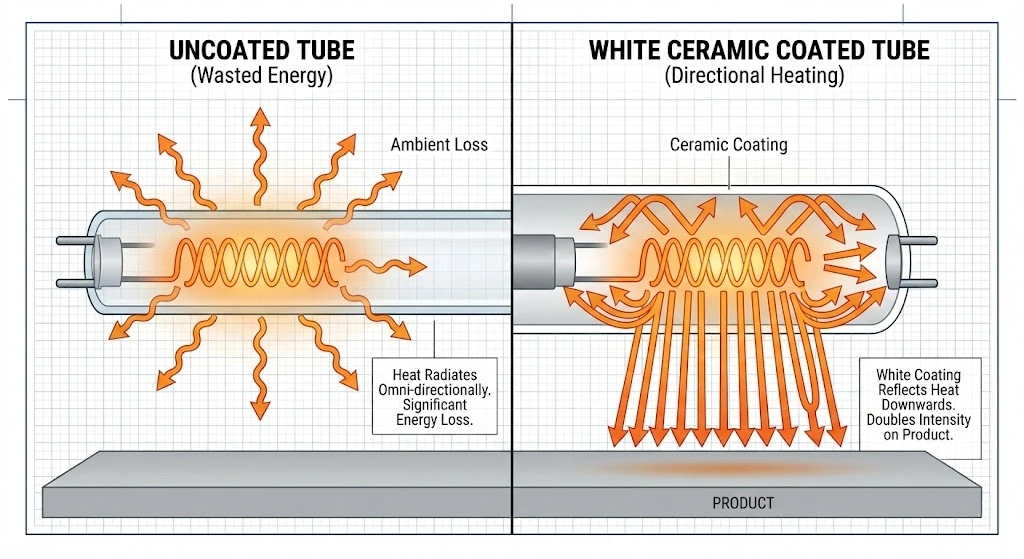
While Gold reflectors are standard for short-wave, Ceramic White (Half-White) coatings are the preferred standard for Carbon Fiber.
- Why: White ceramic is highly reflective of medium-wave radiation and is extremely durable.
- Efficiency: A half-coated tube directs 180° of the energy forward. Without this coating, 50% of your energy heats the back of the oven wall.
FAQ: Common Technical Questions
What is the main difference between Carbon Fiber and Halogen heaters?
Wavelength and Speed. Halogen is Short-Wave (~1.0μm) with instant response (1 sec), ideal for penetration. Carbon Fiber is Medium-Wave (~2.5μm) with slower response (3-5 sec), ideal for surface absorption and drying water/plastics.
Is a carbon fiber heater more energy efficient?
In terms of electrical conversion (Watts in vs. Heat out), both are efficient. However, in terms of Process Efficiency, Carbon Fiber is ~30% more efficient for drying water-based applications because the energy is absorbed by the water rather than passing through it.
Can I replace my existing ceramic heaters with carbon fiber?
Yes, and it is a popular upgrade. Carbon fiber heats up in seconds rather than the 10-15 minutes required for ceramic heaters. This significantly reduces standby energy consumption and allows for faster line start-ups.
Conclusion: Optimization via Physics
If your process involves drying moisture, curing powder coatings, or softening plastics, short-wave halogen is likely costing you money in rejected parts and wasted energy.
Stop fighting the physics. Switch to a wavelength that your material actually wants to absorb.
Ready to eliminate “Solvent Pop” and uneven curing?
Contact Hongtai’s engineering team today. We can retrofit your existing oven with custom-sized Carbon Fiber Emitters designed for maximum absorption efficiency.