In industrial maintenance and laboratory setups, the geometry is rarely flat. You are dealing with ¼-inch stainless steel tubing, complex valve bodies, curved glass beakers, or vacuum exhaust lines. Standard rectangular heating pads simply won’t stick, and rigid cartridge heaters won’t fit.
Technicians need a thermal solution that handles like duct tape but performs like a precision heater.
Enter Silicone Heating Tape. Whether you need to prevent a water line from freezing overnight or heat a distillation column to exactly 120°C, this “wrap-and-go” solution provides immediate, flexible heat.
This guide explores the versatility of HT-Heater’s silicone tapes (a cost-effective alternative to BriskHeat® XtremeFLEX®), detailing installation techniques, the critical “Do Not Overlap” rule, and how to safely heat plastic piping.
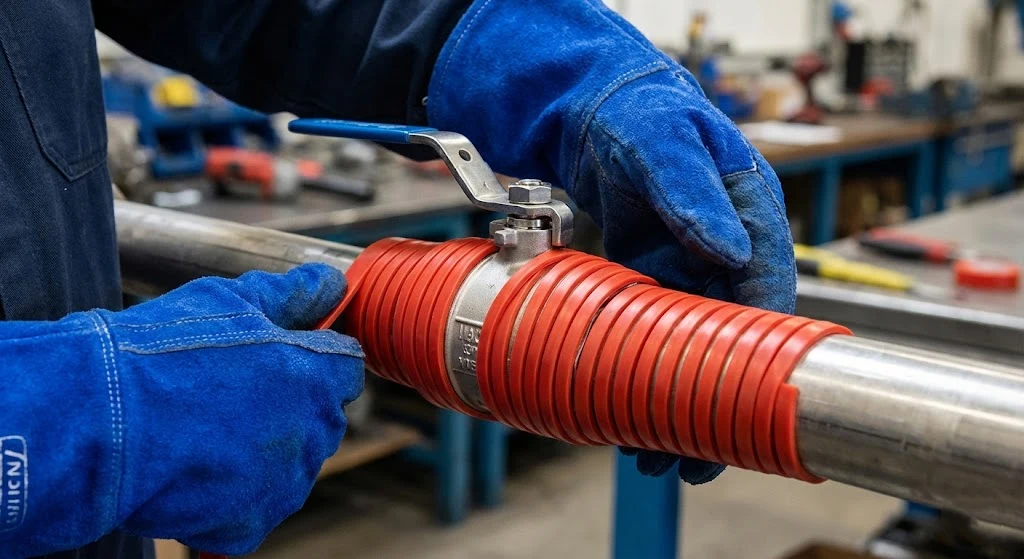
High flexibility allows silicone tapes to conform to complex shapes like valves and pumps where rigid heaters fail.
It is essentially a linear version of our silicone rubber heater mats, optimized for extreme flexibility.
Structural Anatomy
The Core: Multi-stranded Nickel-Chrome (NiCr) resistance wire.
The Insulation: Double-layer fiberglass-reinforced silicone rubber.
The Flexibility: The knitting process allows for a minimum bend radius of just 6mm (0.25″). You can wrap it around a pencil without damaging the element.
Constant Wattage vs. Self-Regulating
Crucial Engineering Distinction:
Most silicone heating tapes are Constant Wattage.
Meaning: They output a fixed amount of heat (e.g., 50 Watts per meter) regardless of the ambient temperature.
Requirement: unlike “Self-Regulating” freeze protection cables (which lower their output as they get warm), silicone tapes MUST be controlled by a thermostat or rheostat. Without control, they can continue to heat until they exceed 250°C and burn out.
2. Typical Application Scenarios
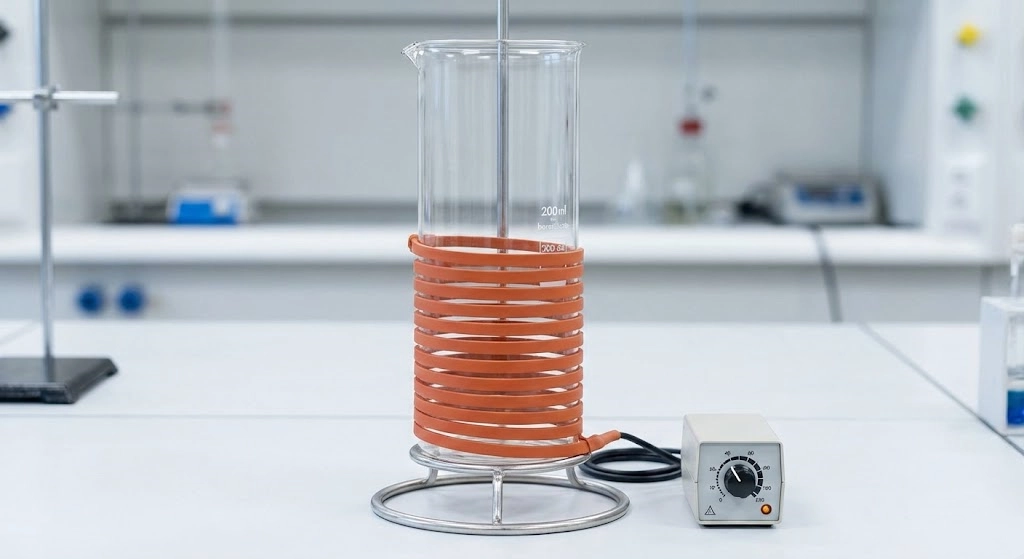
Soft silicone surfaces protect fragile borosilicate glass from thermal shock and mechanical stress.
A. Pipe & Valve Freeze Protection
For small-diameter pipes (< 50mm), bulky insulation jackets are often impractical. Silicone tape provides direct conductive heat. It is widely used in unheated warehouses to keep water lines, fire sprinkler drops, and pneumatic lines flowing in winter.
B. Laboratory Glassware Heating
In chemistry labs, heating mantles are expensive and size-specific. A single heating tape can be wrapped around a beaker, a condenser column, or a funnel. The soft silicone surface ensures intimate contact without crushing fragile glass instruments.
C. Vacuum Pump Exhaust Lines (Anti-Condensation)
In semiconductor and chemical deposition processes, gases pumped out of the chamber can cool and condense into solids (sublimation) inside the exhaust line, clogging the system.
Solution: Wrapping the foreline with heating tape keeps the pipe wall above the sublimation temperature, ensuring gases pass through to the scrubber.
3. Installation Technique: The Spiral Wrap
Proper installation is the difference between a heater that lasts 10 years and one that fails in 10 minutes.
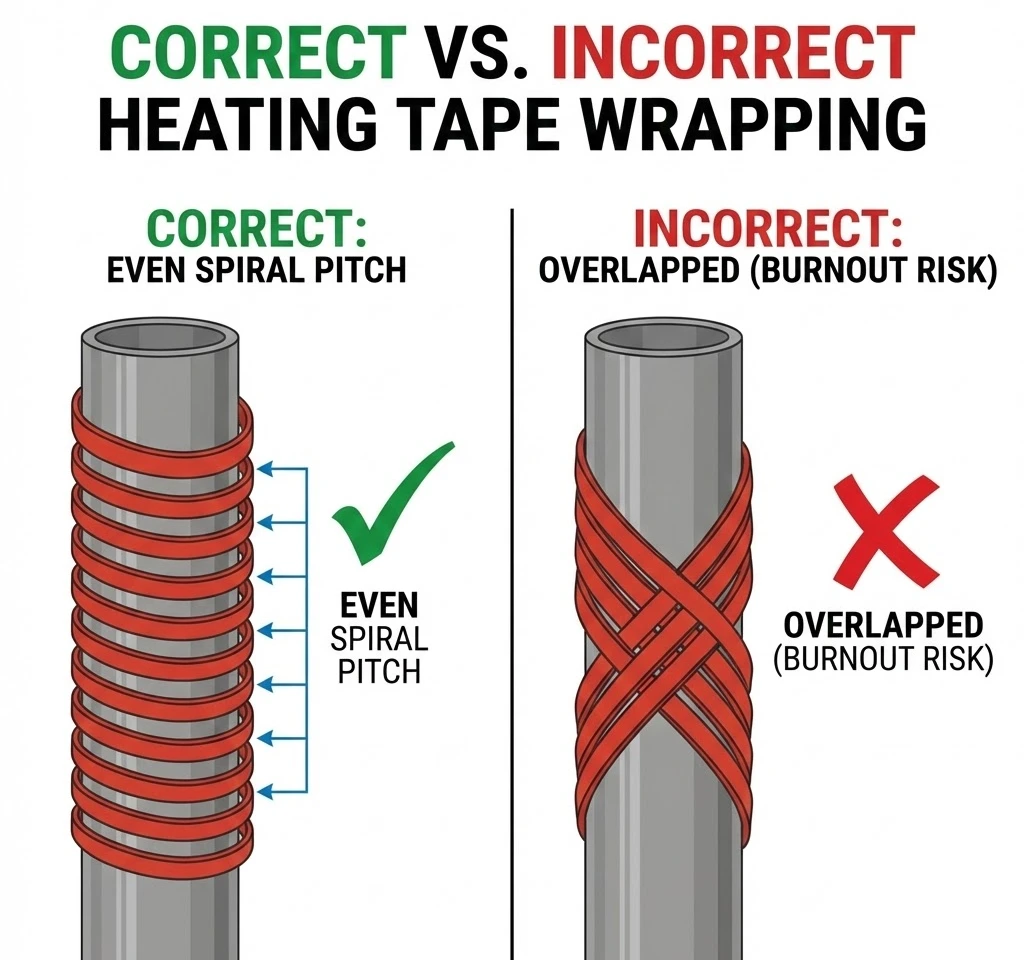
Never overlap constant-wattage heating tape. The localized heat buildup will destroy the insulation.
The Golden Rule: DO NOT OVERLAP
Unless you are using a specific “HT-Heavy Duty” model, never allow the heating tape to cross over itself.
The Physics: At the overlap point, the tape is heating itself from both sides. The temperature will skyrocket instantly, burning through the silicone and causing a short circuit.
Calculating Spiral Pitch
To get the right temperature, you adjust the Pitch (the distance between wraps).
High Heat Input: Close spiral (e.g., 5mm gap between wraps).
Low Heat Input: Loose spiral (e.g., 50mm gap).
Attachment: Secure the ends with high-temperature Fiberglass Tape or Kapton Tape. Do not use standard electrical tape or plastic zip ties (they will melt).
4. Standard Specifications & Specs
We stock a wide range of sizes for immediate MRO dispatch.
Spec
Value range
Note
Width
12mm (0.5″), 25mm (1″), 50mm (2″)
25mm is the industry standard.
Length
0.5m (2ft) to 10m (30ft)
Custom lengths up to 50m available.
Voltage
110V / 220V
12V DC available for mobile use.
Control
None / Dial Controller
“Dial Controller” models have a built-in 0-100% power knob.
Max Temp
250°C (482°F)
Continuous exposure.
5. Pro-Tip: Heating Plastic Pipes
Can you use silicone tape on PVC or PEX pipes? Yes, but with caution.
Plastic conducts heat poorly. If you apply a heater directly, the wire location might get too hot while the rest of the pipe stays cold.
The Aluminum Foil Trick:
Wrap the plastic pipe completely in Aluminum Foil Tape first.
Install the silicone heating tape over the foil.
Result: The aluminum acts as a heat spreader, distributing the energy across the entire pipe circumference and preventing “hot spots” that could melt the plastic.
Frequently Asked Questions (FAQ)
Can I cut the heating tape to a shorter length?
No. Silicone heating tapes are designed with a specific total resistance to match the voltage. Cutting the tape reduces the resistance, which causes the current (Amps) to spike. This will instantly burn out the element and trip your breaker. If you have excess length, wrap it loosely around a nearby non-flammable object or increase the spiral pitch.
Is the tape waterproof?
Standard models are rated IP54 (splash resistant). They are fine for occasional dampness but cannot be submerged. For outdoor use exposed to heavy rain, we recommend covering the installation with waterproof insulation foam or ordering our IP65 Molded End version.
Do I need a temperature controller?
Yes. Since these are constant wattage heaters, they will keep getting hotter until they reach thermal equilibrium or fail. For simple freeze protection, a Preset Thermostat (e.g., ON at 4°C, OFF at 10°C) is the most set-and-forget solution. For process heating, use a Dial Controller or Digital PID.
Got a frozen pipe or a cold beaker? Don’t wait for a burst line. Stock up on HT-Heater’s universal maintenance tapes today.