It is a non-negotiable rule of electrochemistry: Never charge a LiFePO4 (LFP) battery below 0°C.
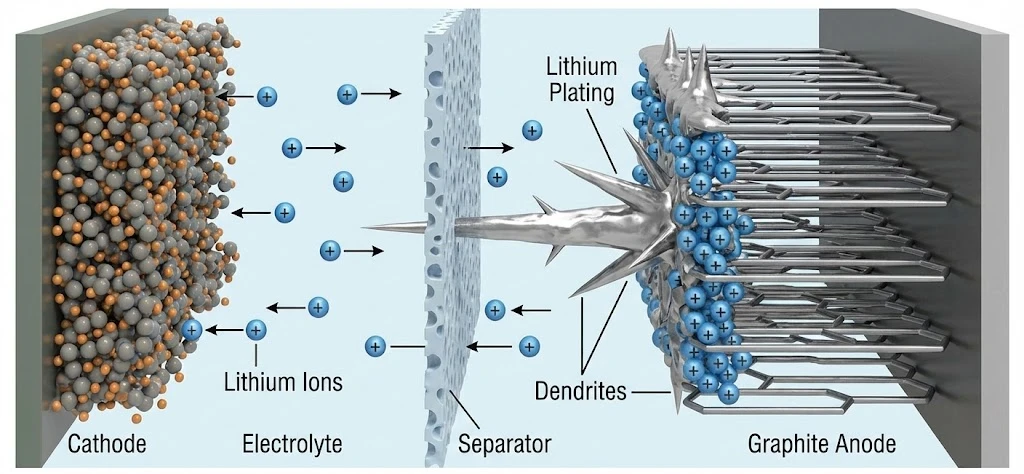
Doing so doesn’t just reduce efficiency; it causes irreversible Lithium Plating on the anode. This leads to permanent capacity loss and, in severe cases, the formation of dendrites that can pierce the separator and cause a short circuit.
For thermal engineers designing outdoor Energy Storage Systems (ESS), electric trucks, or AGVs operating in cold storage, the challenge is clear: How do you evenly raise the cell temperature to +5°C before the BMS permits charging?
This guide explores Low-Voltage Silicone Heating Solutions designed specifically for battery packs. We will analyze the thermal advantages of Etched Foil technology over wire-wound elements to eliminate dangerous “hot spots,” compare side-plate vs. bottom-plate heating, and discuss the latest OEM integration strategies involving foam insulation.
1. The Physics of Failure: Why Batteries Need Heat
Charging at sub-zero temperatures causes lithium metal plating, the precursor to catastrophic battery failure.
The 0°C Charging Prohibition
At low temperatures, the electrolyte viscosity increases, and the ionic conductivity of the Solid Electrolyte Interface (SEI) drops. If you force current into the cell, lithium ions cannot intercalate into the graphite anode fast enough. Instead, they deposit as metallic lithium on the surface.
The Engineering Consequence: Once plating occurs, it is permanent. The battery’s internal resistance (IR) spikes, and its cycle life is decimated.
Discharge Performance Drop
While discharge is safer than charging, it is inefficient. At -20°C, a standard Lithium-ion cell may only deliver 50-60% of its rated capacity due to voltage sag.
Solution: An active pre-heating system ensures the pack remains in its optimal operating window (15°C – 35°C), preserving range and power output.
2. Why Silicone Heaters are the EV Standard
Etched foil technology is mandatory for batteries to prevent localized overheating of individual cells.
Liquid cooling/heating plates are effective but heavy and expensive. For many applications, Flexible Silicone Heaters offer the optimal balance of weight, cost, and efficiency.
Space Optimization
Battery packs are density-maximized. With a thickness of just 1.5mm (or thinner with Polyimide), silicone heaters can be adhered directly to the side or bottom of prismatic cells without requiring a redesign of the pack housing.
The Safety of Etched Foil
For battery applications, we strictly recommend Etched Foil elements over wire-wound.
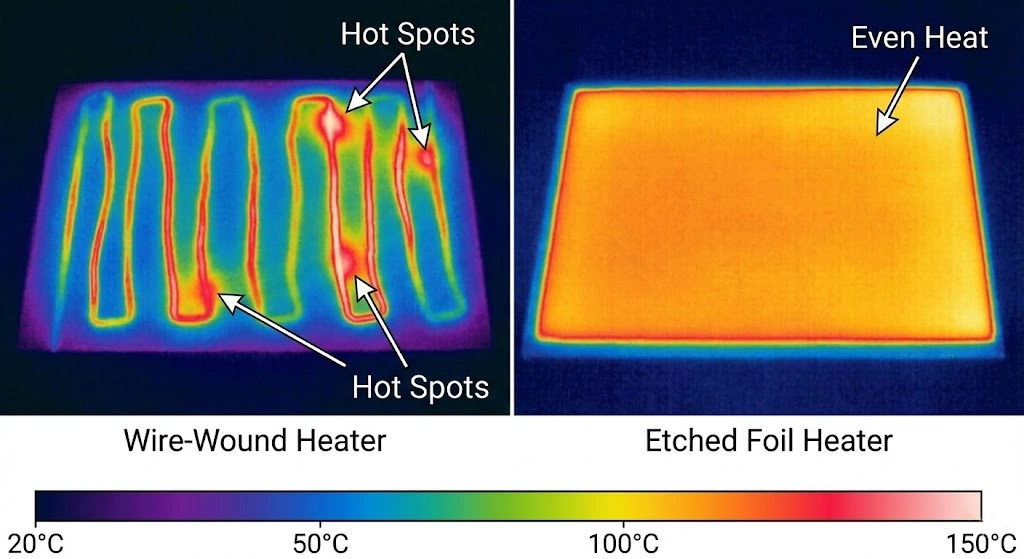
The Risk: Wire-wound elements create linear heat concentrations. If a wire runs across a single point on a pouch cell, that point could overheat while the rest of the cell is cold.
The Solution: Etched foil circuits function like a PCB, covering 80-90% of the surface area. This creates a “planar heat source” that warms the cell uniformly, mitigating the risk of Thermal Runaway.
Learn more about this manufacturing process in our [Flexible Heater Technology Overview].
3. Low Voltage Design: 12V/24V/48V Systems
To maximize efficiency, the heating system should run directly off the battery bus, bypassing the inverter.
Direct DC Coupling
12V / 24V: Common for AGVs, forklifts, and portable power stations.
48V / 72V: Standard for telecom base stations (ESS) and light electric vehicles (LEVs).
HV (400V+): For automotive EV packs, we design high-voltage isolation heaters with dielectric strengths exceeding 2500V.
The “Low and Slow” Power Density Rule
Unlike industrial heating where we aim for speed, battery heating requires patience.
HT-Heater Design Standard: We recommend a Watt Density of 0.1 W/cm² to 0.2 W/cm².
Why? Heat needs time to conduct through the cell casing and into the core. High power (e.g., 0.6 W/cm²) will cook the casing while the core remains frozen, creating a damaging thermal gradient ($Delta T$).
Validate your design parameters with our [Watt Density Calculator].
4. OEM Innovation: The “Heater-Insulation Sandwich”
Integrated thermal assemblies combine heating, insulation, and compression padding into a single SKU.
Top-tier battery integrators are moving away from buying just a heater. They want a Thermal Sub-assembly.
The “3-in-1” Solution:
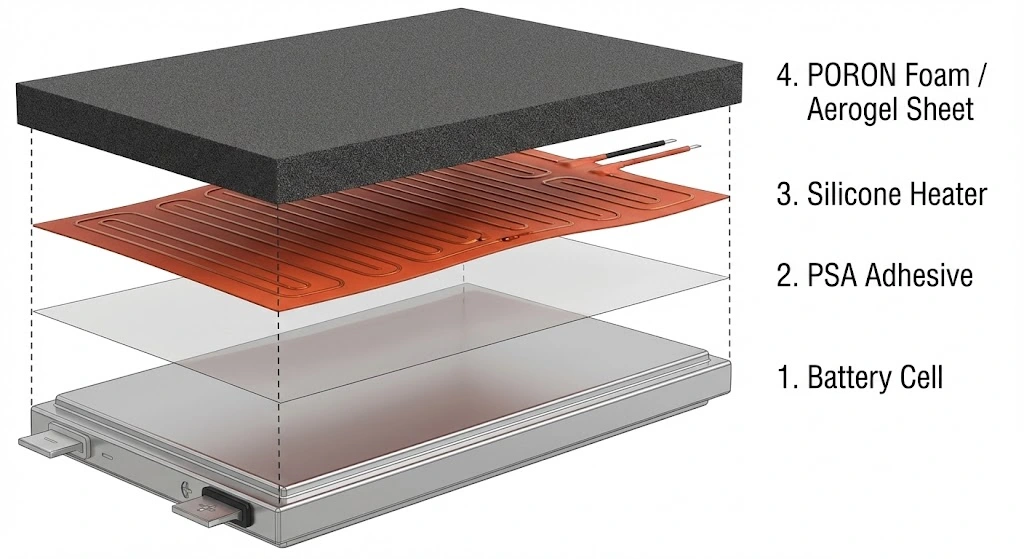
We laminate the silicone heater directly to a layer of PORON® Foam or Aerogel Felt.
Active Heating: The silicone layer warms the cells.
Passive Insulation: The foam prevents that heat from escaping into the chassis.
Mechanical Buffer: The foam absorbs the natural expansion/swelling of the cells during charge/discharge cycles.
5. Application Case Studies
A. Cold Chain AGV (Automated Guided Vehicle)
Problem: An automated forklift in a -25°C ice cream warehouse experienced 40% range loss and charging errors.
Solution: We installed a 24V, 200W Silicone Heater on the bottom of the battery tray.
Control: Integrated NTC 100K thermistor connected to the BMS. When the BMS detects a temp < 5°C, it triggers the heater relay. Charging is disabled until T > 5°C.
B. 5G Telecom Base Station (Outdoor Cabinet)
Problem: Backup LiFePO4 batteries in remote towers in Canada were freezing in winter.
Solution: A low-wattage (0.05 W/cm²) “heating jacket” wraps around the battery module.
Feature: Integrated independent thermostat set to Close at 0°C and Open at 10°C, ensuring the battery is always ready without draining excess power.
6. Heating Strategy by Chemistry
Different chemistries have different thermal tolerances. Use this table as a baseline for your BMS logic.
Battery Chemistry
Trigger ON Temp
Trigger OFF Temp
Rec. Watt Density
Critical Risk
LiFePO4 (LFP)
0°C
10°C
0.1 W/cm²
Lithium Plating during charge.
NCM / NCA
-5°C
15°C
0.15 W/cm²
Sensitive to Thermal Runaway if overheated.
Lead Acid (AGM)
-10°C
25°C
0.3 W/cm²
Electrolyte freezing / Sulfation.
Solid State
50°C
80°C
0.5 W/cm²
Requires high heat to activate ionic transport.
Frequently Asked Questions (FAQ)
Can you integrate the heater control with our BMS?
Yes. We do not need to supply a separate controller. We can embed NTC Thermistors (10K, 100K) or Thermocouples directly into the silicone mat. The signal wires connect to your BMS, allowing your software to manage the thermal logic (e.g., “If Temp < 0°C AND Charger Connected = Turn ON Heater”).
Are silicone heaters flammable?
No. For battery applications, we use specific UL94 V-0 rated flame-retardant silicone rubber. In the event of a catastrophic battery fire, the heater material will self-extinguish and will not contribute fuel to the fire.
Should I heat the sides or the bottom of the battery?
Bottom heating is often preferred for ease of assembly (placing the pack onto a heated mat). However, side heating (between cells) is thermally superior because it covers more surface area and reduces the thermal path length to the core of the cell.
Designing a Pack for the Arctic? Don’t let cold weather compromise your warranty. Partner with HT-Heater for UL-compliant, automotive-grade thermal solutions.