In electromechanical design, thermal management is often a battle against geometry. When you need to apply precise heat to compound curves, vacuum chambers, or tight spaces, rigid metal heaters simply fail—not due to lack of power, but due to contact resistance.
Engineers don’t just need a heating element; they need a “thermal skin” that eliminates the insulating air gaps inherent in rigid systems. Flexible heaters solve this by bridging the gap between thermodynamics and mechanical constraints.
This guide is your technical white paper. We move beyond sales fluff to dissect the physics of flexible heating, compare substrate behaviors (Silicone vs. Kapton), and provide the failure analysis data you need to specify the right component.
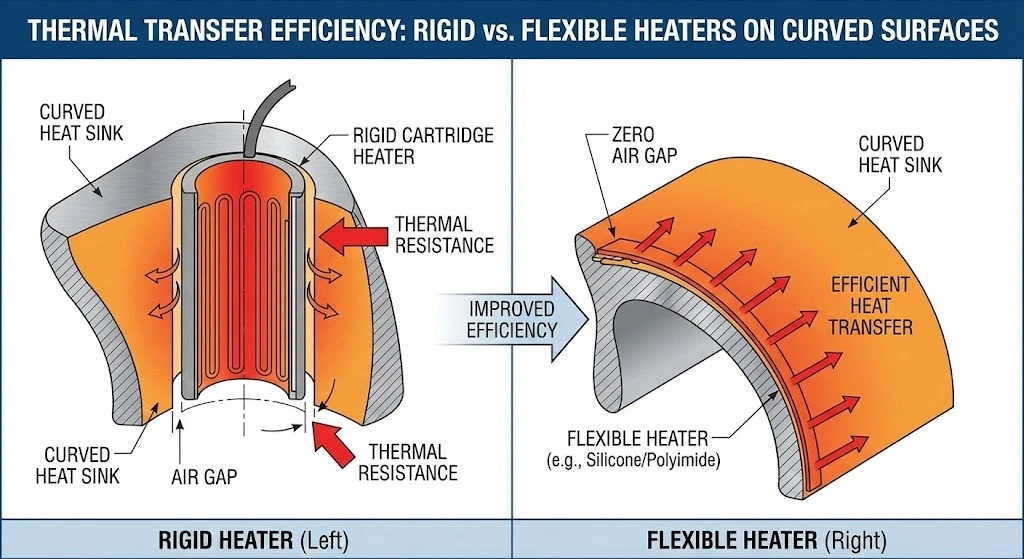
Diagram comparing thermal transfer efficiency of rigid heaters vs flexible heaters on curved surfaces.
Why does “flexibility” matter mechanically? It comes down to Fourier’s Law of Heat Conduction: q = -kA(dT/dx).
In this equation, contact area (A) is king. A traditional tubular heater on a curved pipe might only achieve 5-10% actual surface contact. The remaining 90% is an air gap—a thermal insulator. To compensate, you have to overdrive the heater core temperature, shortening its life.
Flexible heaters, with thicknesses ranging from 0.15mm (Polyimide) to 1.5mm (Silicone), conform to the substrate. This achieves near 100% surface contact, allowing you to run at lower internal temperatures while delivering more energy to the load.
2. Substrate Selection: Silicone Rubber vs. Polyimide (Kapton®)
Your choice of insulation material dictates the heater’s mechanical durability and thermal response speed.
Silicone Rubber: The Industrial Workhorse
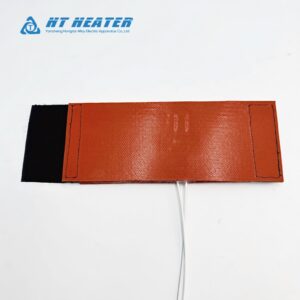
HT-Heater’s silicone elements are a composite of fiberglass-reinforced silicone rubber sheets.
The “Why”: The 1.5mm thickness acts as a mechanical cushion. It absorbs vibration and shock, making it ideal for heavy machinery.
Key Specs (Lab Data):
Temp Range: Stability from -60°C to 250°C (Continuous).
Dielectric Strength: Withstand voltage > 1.5KV.
Insulation Resistance: ≥5MΩ.
Best For: Freeze protection, viscosity control (drums), and outdoor enclosures requiring moisture resistance (IP65 capable).
Polyimide (Kapton®): The Precision Film
The “Why”: At ~0.2mm thick, Kapton has negligible thermal mass. This results in near-zero Thermal Hysteresis—the heater heats up and cools down instantly with the power supply.
Vacuum Performance: Unlike silicone, which can outgas trace volatiles in high vacuum, Polyimide is clean and chemically inert, making it the standard for aerospace and optics.
Best For: Medical diagnostic devices, 3D printers, and vacuum chambers.
3. Internal Construction: Etched Foil vs. Wire Wound
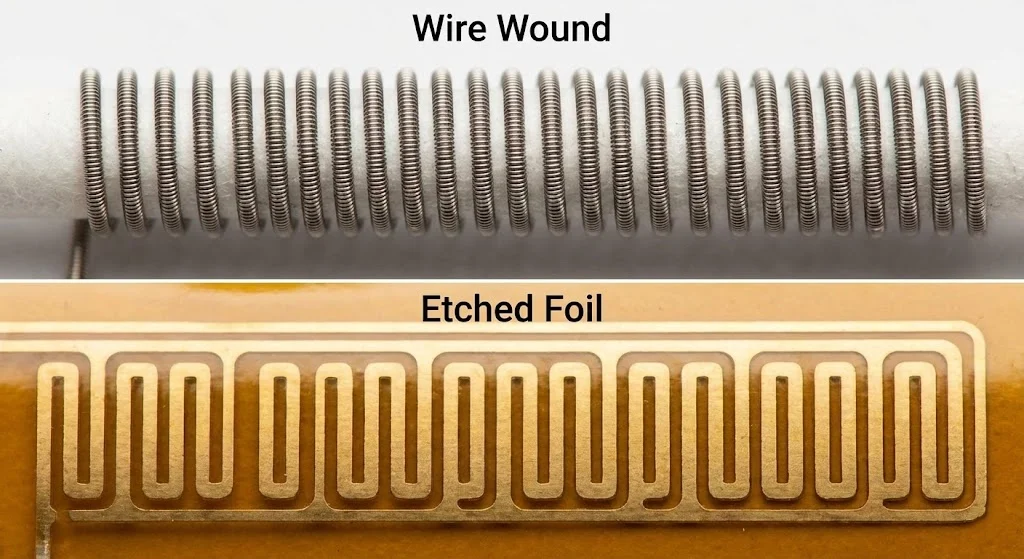
Macro comparison of wire wound vs etched foil heating element patterns.
The “engine” inside the heater matters just as much as the skin.
Wire Wound (Legacy Tech):
Process: Resistance wire is hand-wound around a fiberglass core.
Drawback: The round wire creates a “point contact” with the insulation, leading to higher internal wire temperatures.
Use Case: Prototyping and very large, simple shapes.
Etched Foil (Modern Standard):
Process: Acid etching of a flat Nickel-alloy foil, similar to PCB manufacturing.
Advantage:Surface Area Coverage. The flat foil covers 50-70% of the heater surface area (vs. <20% for wire). This lowers the watt density at the element itself, significantly extending life.
Precision: Allows for Distributed Wattage—we can design higher power density at the edges to compensate for perimeter heat loss.
4. Engineering Failure Analysis: Watt Density
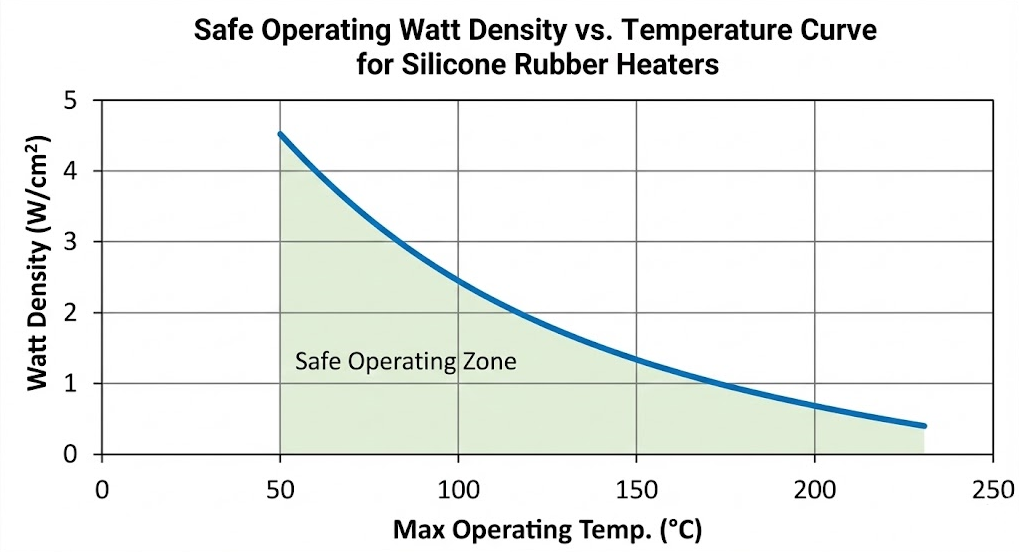
Safe operating watt density vs temperature curve for silicone rubber heaters.
The #1 cause of heater failure is ignoring Watt Density.
Watt Density is the power flux flowing through the heater surface ($W/cm^2$). If this flux exceeds the rate at which the heat sink (your part) can absorb it, the energy backs up, and the heater burns out.
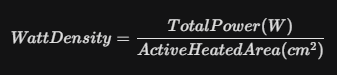
The Safety Formula
Note: Active area is typically 10-15% smaller than physical size due to unheated margins.
HT-Heater Design Guidelines:
PSA Mounting (Adhesive): Keep below 0.6 W/cm². The limiting factor here is the adhesive, not the silicone.
Vulcanized/Clamped: Can handle up to 0.8 W/cm² (or higher with engineering review) because the perfect bond acts as a high-efficiency heat sink.
Engineering Tip: If you need 5 W/cm², a flexible heater is likely the wrong technology. You may need a high-density cartridge heater.
5. Industrial Applications & Data Specs
A. Viscosity Control: Oil Drum Heaters
In cold climates, contents like asphalt, resin, or heavy oils become un-pumpable.
HT-Heater Spec: We manufacture specific silicone belts for standard drums.
55-Gallon (200L) Drum:
Size: 250mm x 1740mm.
Power: 2000W (decreases viscosity without scorching).
Features: Integrated spring fasteners and 30-150°C thermostat.
5-Gallon (20L) Pail:
Size: 200mm x 860mm.
B. Medical & Life Sciences
Application: Blood analyzers and IVD devices.
Requirement: Precise 37°C maintenance.
Solution: Kapton heaters with integrated NTC thermistors and thermal fuses for redundant safety.
C. 3D Printing (Heated Beds)
Application: Preventing ABS/PETG warping.
Spec: Large format silicone mats (up to 1000mm) with PSA backing ensure uniform heat distribution across the entire build plate.
6. Installation: The Chemical Bond
How you attach the heater is as critical as the heater itself.
Pressure Sensitive Adhesive (PSA):
Standard: 3M 467MP or 468MP.
Chemistry: Acrylic-based. Excellent bond strength but degrades above 150°C.
Best For: Fast assembly on flat or cylindrical surfaces.
Factory Vulcanization:
Process: The uncured heater is bonded to your metal part under heat and pressure in our factory.
Result: A chemical bond that handles the full 250°C limit of the silicone. Zero risk of delamination.
Mechanical Fastening:
Springs / Velcro: Used when the heater must be removable (e.g., drum heaters).
7. Customization Checklist: Defining Your RFQ
To get an accurate engineering drawing and quote, please define the system, not just the part.
Target: What is the object material (Aluminum, Steel, Plastic) and mass?
Temp Profile: Start temp, Target temp, and required Ramp-up time.
Dimensions: 2D drawing with cable exit location.
Power Source: Mains (110/220V) or Low Voltage DC (12/24/48V)?
Control: Do you need a built-in thermostat, thermocouple (K/J), or thermistor?
Frequently Asked Questions (FAQ)
Can I cut the heater to size during installation?
No. Flexible heaters contain a specific internal circuit pattern. Cutting the material will sever the resistance element, creating an open circuit or a dangerous electrical short. All dimensions and holes must be tooled during manufacturing.
What is the lead wire type?
We standardly use Silicone Braided Wire or Teflon (PTFE) wire. These are rated to match the heater’s temperature capabilities and are strain-relieved at the exit point to prevent breakage.
Does voltage affect temperature?
No. A 12V heater and a 220V heater designed for the same wattage (e.g., 100W) will produce the same heat. However, lower voltage requires much higher amperage (Current = Power / Voltage), which requires thicker lead wires.
What is the maximum size you can manufacture?
For Silicone Rubber, we can produce continuous sheets up to 1000mm x 1200mm. For larger requirements, we can splice multiple mats together or design a modular system.
Solve your thermal challenges with precision.
Stop guessing with generic components. Contact the HT-Heater engineering team for a full thermal analysis and custom quote.