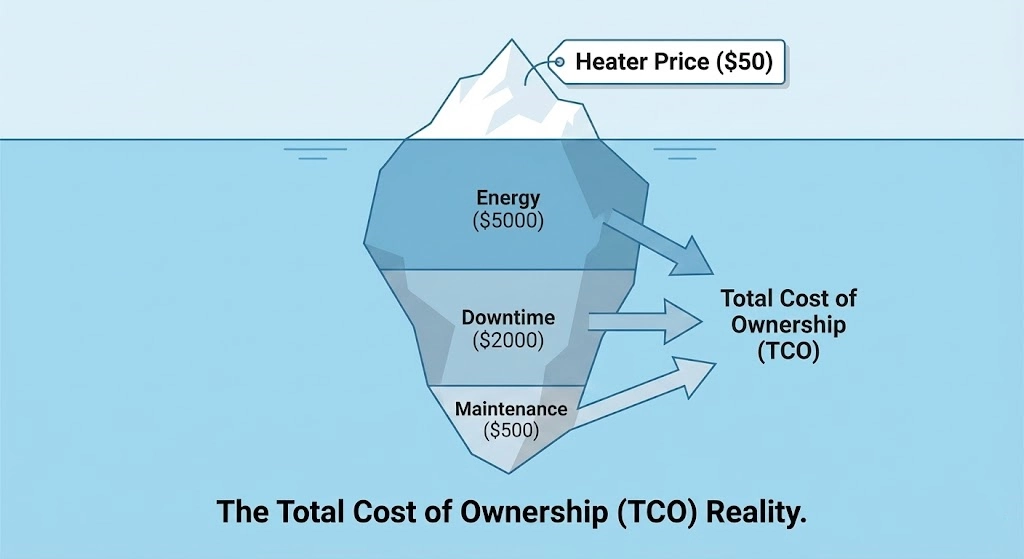
The Iceberg Theory: The $50 Component Costing You $5,000
When evaluating industrial heating costs, purchase price is only the tip of the iceberg. In the procurement office, the focus is often on the unit price. A $50 tubular heater seems like a commodity. But in the utility room, that same heater is an energy-hungry asset running 24/7.
The Economic Reality: A single 10kW heater running 12 hours a day consumes approximately 36,000 kWh per year. At an industrial rate of $0.14/kWh, that is $5,040 in electricity.
- The Thesis: If an inefficient design (wrong material, poor internal compaction) wastes just 10% of that energy, you are burning $500 per year, per heater—ten times the cost of the component itself.
This article dissects the thermodynamics of this waste and demonstrates how specific engineering choices—based on Hongtai’s manufacturing standards—can reclaim that lost margin.
1. Micro-Physics of Heat Transfer: Where the Energy Goes
Why does one heater use more energy to do the same job? The answer lies in Thermal Resistance.
The MgO Purity Factor
Inside the tube, the heat must travel from the wire to the sheath through the insulation.
- The Spec: We utilize high purity magnesium oxide (MgO) powder compacted to near-solid density1.
- The Efficiency Logic: Low-grade, loose MgO acts like a thermal blanket, trapping heat inside. To achieve a sheath surface temperature of 500°C, a generic heater might need to drive its internal wire to 900°C. A Hongtai heater, with superior compaction and conductivity2, might only need 750°C.
- The Result: That 150°C differential represents wasted energy dissipated as ambient loss at the terminals and accelerated component degradation.
Resistance Wire Precision
- The Spec: We use precision helical wound nickel-chrome resistance wire3.
- The Efficiency Logic: Uneven winding creates “Hot Spots.” In physics, resistance increases with temperature. A hot spot draws more current, gets hotter, and scales up faster than the rest of the tube. This localized inefficiency forces the entire system to work harder to maintain average process temperatures.
2. The Energy Thief: Scale Buildup
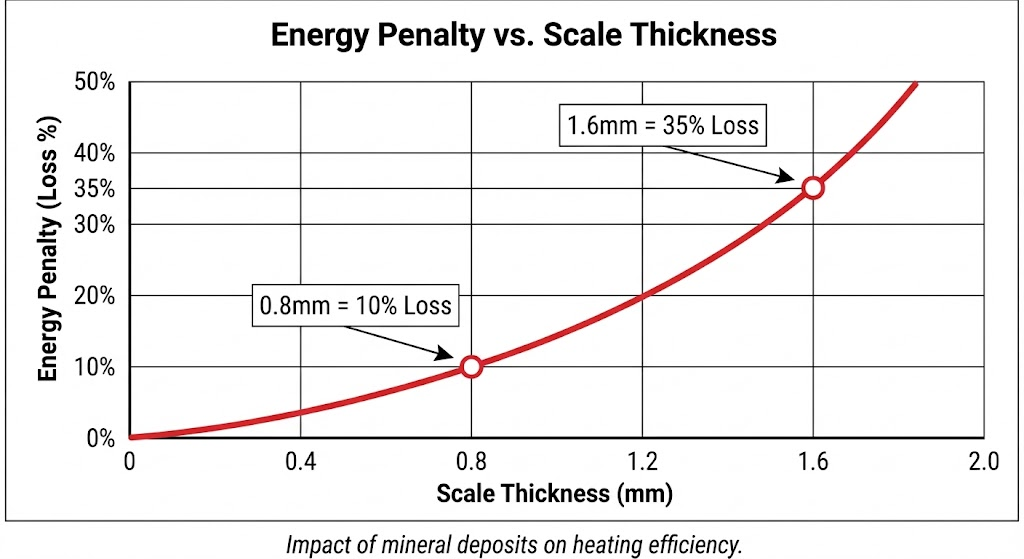
Scale (Calcium/Magnesium carbonate) is not just a maintenance nuisance; it is a financial liability. Scale is a thermal insulator.
- The Data: Just 1mm of scale on a heater sheath can decrease heat transfer efficiency by 10% to 15%.
The Material Economic Model
- Scenario: Heating hard water.
- Standard Choice: Stainless Steel 3044. Its surface is microscopically rougher, encouraging mineral adhesion.
- The Optimization: Upgrade to Incoloy 8005. While the initial material cost is higher, the alloy’s superior oxidation resistance provides a smoother surface profile that resists scale adhesion.
- ROI Calculation: Paying $20 extra for Incoloy 800 is recovered in less than one month of energy savings (avoiding the 10% scale penalty), plus the elimination of two acid-wash maintenance cycles per year.
3. Design for Efficiency: Watt Density & Thermal Lag
A common procurement mistake is buying small, high-powered heaters to save space and money. This creates High Watt Density.
The Thermodynamic Penalty
When Watt Density is too high, the liquid in direct contact with the sheath vaporizes instantly, forming a vapor barrier (Film Boiling). Gas is a poor conductor.
- The Waste: The heater is now insulated by a layer of steam. It consumes maximum power but transfers minimal heat to the bulk liquid.
- The Solution: Utilize Hongtai’s capability to manufacture elements up to 7000mm in length 6and diameters up to 25mm7. By spreading the same wattage over a larger surface area (Low Watt Density), you maintain “Nucleate Boiling”—the most efficient heat transfer regime.
The Cold Zone Detail
- The Spec: Our elements feature an integral cold pin8.
- The Savings: If a heater’s active zone extends into the mounting flange or insulation, that heat is lost to the atmosphere (and cooks your gaskets). We precisely calculate the Heated Length to ensure 100% of the energy generation occurs immersed in the process fluid.
4. Control Synergy: The Death of On/Off
Pairing a high-efficiency Hongtai heater with a cheap contactor (On/Off control) is like driving a Ferrari in stop-and-go traffic.
- The Problem: On/Off control causes massive thermal overshoot and undershoot. The heater constantly cycles from cold to maximum temp. This Thermal Shock fatigues the element and wastes energy during the “catch up” phase.
- The Recommendation: Switch to SCR (Thyristor) Power Controllers. They modulate the voltage to provide a steady thermal output, matching the load exactly. This can reduce energy consumption by 5-10% and double the heater’s life.
5. Business Case: Total Cost of Ownership (TCO)
Let’s run the numbers for a 3-Year Operational Period.
| Cost Category | Scenario A: Generic Heater | Scenario B: Hongtai Optimized |
| Purchase Price | $20 (Replaced every 6 months) | $40 (Replaced every 18 months) |
| 3-Year Hardware Cost | $120 (6 units) | $80 (2 units) |
| Annual Energy Cost | $5,500 (Inefficient Heat Transfer) | $5,000 (Optimized Watt Density) |
| Maintenance Labor | $500/year (Descaling/Swapping) | $100/year (Inspection only) |
| 3-Year Total Cost | $18,120 | $15,380 |
The Verdict: The “expensive” Hongtai option saves $2,740 per heater over three years.
Frequently Asked Questions (FAQ)
Q: Why does a custom heater save money compared to a cheaper standard stock unit?
Stock heaters are built for “general purpose,” which often means a high Watt Density to fit small tanks. This compromise leads to inefficiency. A custom Hongtai heater is engineered with the exact Watt Density and Length 9 for your specific medium (e.g., Oil vs. Water vs. Acid). By optimizing the surface load, we prevent energy-wasting scale buildup and vapor barriers, reducing annual energy bills by 10-15%. The savings usually pay for the hardware difference in under 3 months.
Q: How does magnesium oxide (MgO) purity affect my electric bill?
MgO is the bridge that carries heat from the electric wire to the water/oil. Low-purity MgO acts like a traffic jam for heat—it has high thermal resistance. This forces the internal resistance wire to run much hotter to push the same amount of heat out, wasting energy in the process. Hongtai uses high-purity, highly compacted MgO 10 to ensure near-lossless thermal transfer, meaning every watt you pay for actually heats your product.
Q: Can upgrading to Incoloy 800 really reduce downtime?
Yes. In high-temperature or corrosive applications, standard Steel or SS304 sheaths degrade rapidly, requiring frequent replacement shutdowns. Incoloy 800 11 is a superalloy designed for temperatures up to 800°C with superior oxidation resistance. By lasting 2-3 times longer than standard alloys in harsh environments, it drastically reduces the “Downtime Cost”—which, for most factories, is far more expensive than the heater itself.
Optimizing your industrial heating costs is not just about saving money, it’s about competitive advantage.