The Engineering Context: It’s Not the Wire, It’s the Sheath
When selecting heating elements for industrial applications, the choice often comes down to Incoloy 800 vs 304 Stainless Steel. Understanding the differences in corrosion resistance, temperature limits, and cost is crucial for your project’s success.
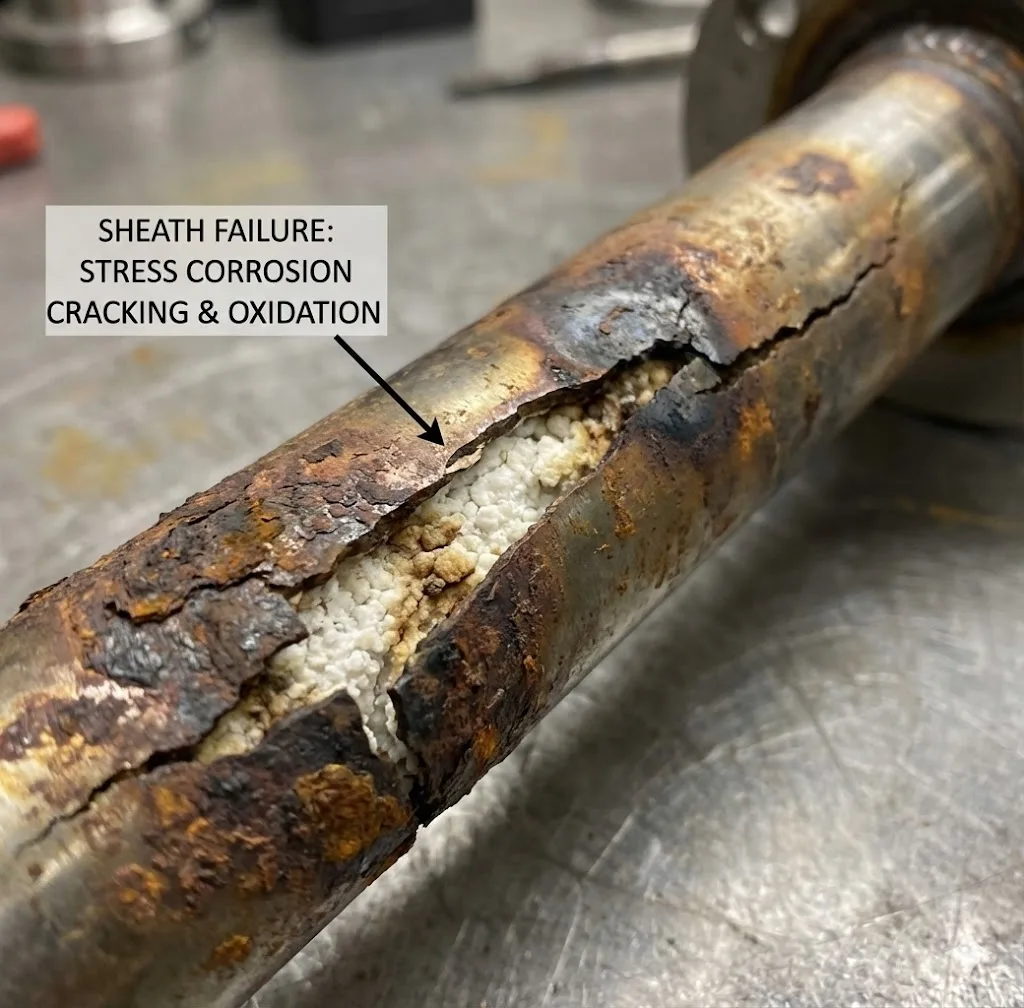
In industrial heating element failure analysis, a staggering 60% of breakdowns are not caused by the resistance wire burning out, but by the failure of the outer sheath material. When a heater “shorts out,” it is often because the sheath compromised due to Stress Corrosion Cracking (SCC) or high-temperature oxidation, allowing moisture to breach the magnesium oxide insulation.
For mechanical engineers creating a BOM (Bill of Materials), the default choice is often AISI 304 Stainless Steel due to its cost-effectiveness. However, strictly adhering to ASTM standards and thermal data reveals that 304 has hard limits.
This guide provides an objective, data-driven comparison between the industry workhorse, Stainless Steel 304, and the high-performance superalloy, Incoloy 800, to help you engineer a more robust thermal system.
1. Thermal Stability Limits: 650°C vs. 800°C
The primary differentiator between these two alloys is their maximum safe operating temperature. This is not just about melting points; it is about maintaining structural integrity under thermal stress.
Max Operating Temperature & Sensitization
According to standard manufacturing specifications, the safe operating limits are distinct:
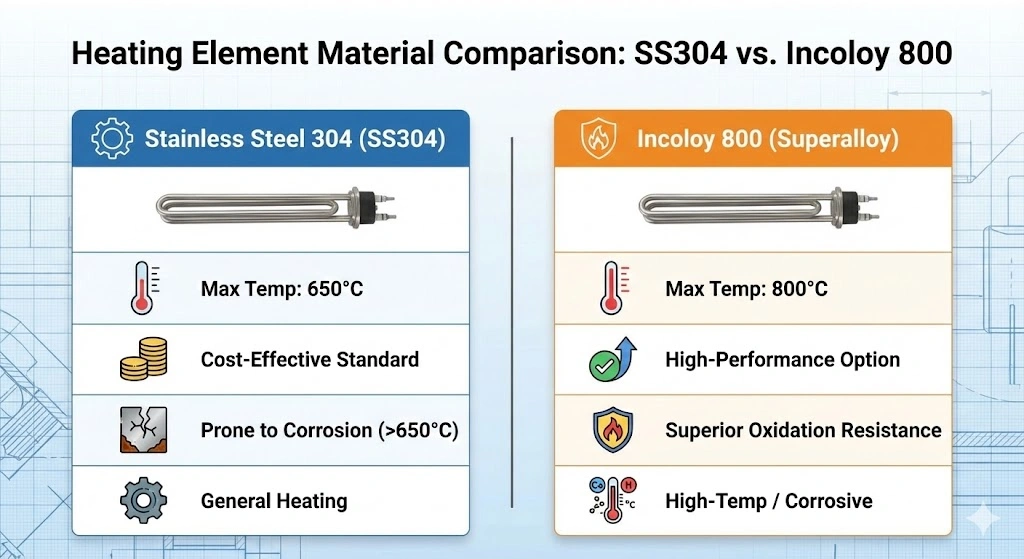
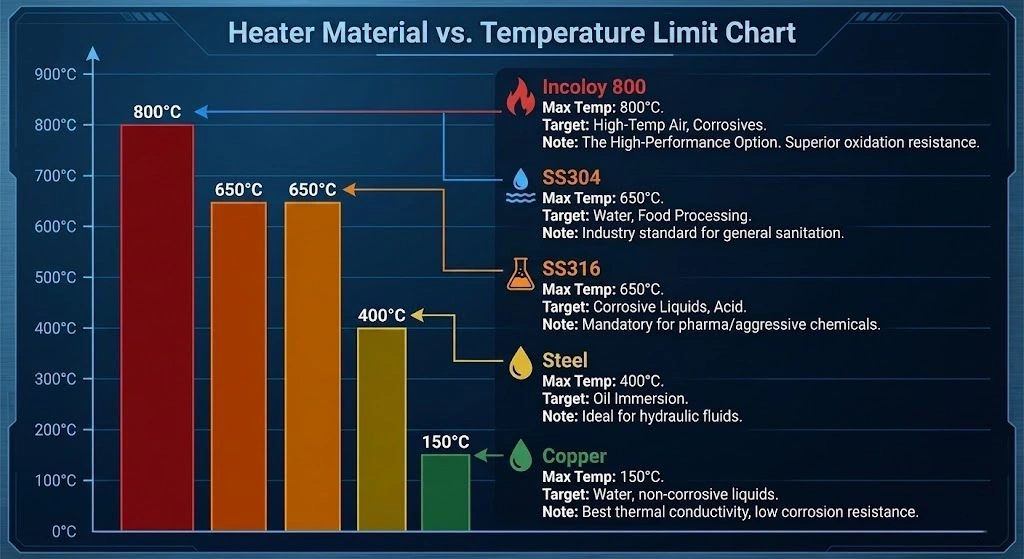
Stainless Steel 304: Rated for a maximum sheath temperature of 650°C.
Incoloy 800: Rated for a maximum sheath temperature of 800°C.
The Engineering Logic:
When SS 304 is exposed to temperatures above 650°C (or dwells in the 425°C–850°C range), it is prone to carbide precipitation (sensitization) at the grain boundaries. This depletes chromium, making the material brittle and susceptible to intergranular corrosion.
In contrast, Incoloy 800 (a Nickel-Iron-Chromium alloy) maintains a stable austenitic structure at 800°C. Its higher Nickel content (typically 30-35%) prevents the sigma phase embrittlement that plagues standard stainless steels at elevated temperatures.
The “Air Heating” Trap: Surface Load
Why does this matter if your oven is only set to 300°C?
In Air Heating applications, heat transfer is inefficient. To heat air to 300°C, the surface temperature of the element often spikes above 700°C.
Recommendation: For static air heating or high-watt-density air applications, Incoloy 800 is the mandatory engineering choice 3 to prevent rapid sheath oxidation.
2. Corrosion Kinetics: Water, Oil & Chemical Selection
Temperature is only half the equation. The chemical interaction between the sheath and the medium dictates the lifespan.
Water Heating: The Risk of Pitting
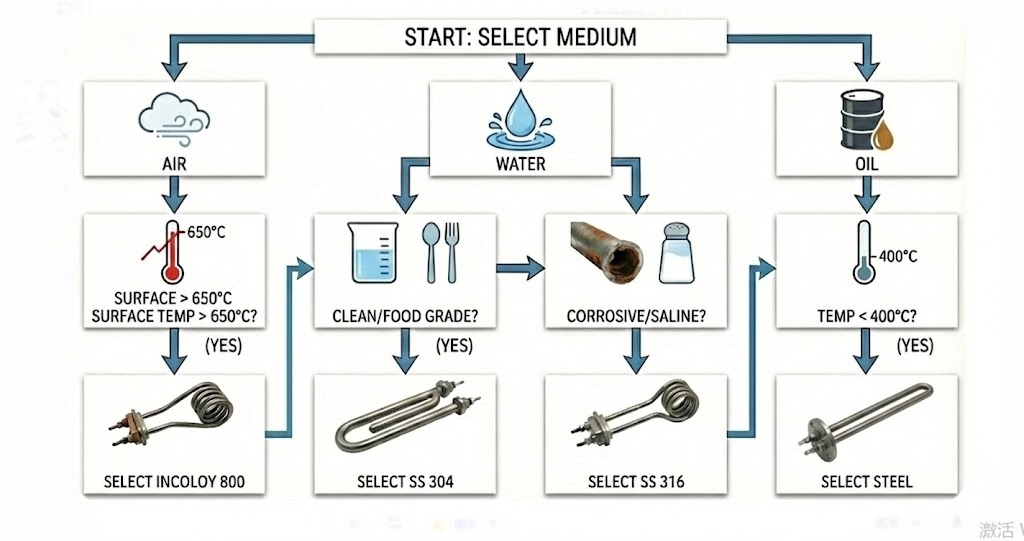
Stainless Steel 304: This is the standard material for water heating, food processing, and mild corrosive liquids. It performs well in clean, neutral pH water.
The Limitation: In environments with high chloride content (e.g., untreated tap water or saline solutions), 304 is susceptible to pitting corrosion.
The Upgrade Path: For corrosive liquids, we recommend upgrading to Stainless Steel 316 or Incoloy 800, which offers superior resistance to chloride-ion stress corrosion cracking.
Oil Immersion: Why Steel?
Steel (Carbon Steel): Industry standards recommend plain Steel for oil immersion up to 400°C.
Why not Incoloy? Oil is generally non-corrosive to steel. Using Incoloy 800 for standard hydraulic oil heating is over-engineering and adds unnecessary cost, unless the application requires “Food Grade” purity where iron contamination is prohibited.
Acidic Environments & Intergranular Issues
In specific chemical processes where intergranular corrosion is a known risk, standard 304 may fail at the welds.
The Solution:Stainless Steel 321. This alloy is stabilized with Titanium, specifically designed to counter intergranular corrosion situations.
[Material Selection Decision Tree]
3. Mechanical Properties: Clamp-on & Deformation
Not all heaters are immersed. Many are clamped onto the outside of tanks or molds.
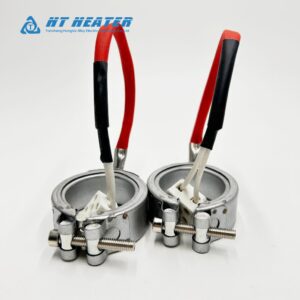
Clamp-on Applications
For Clamp-on heaters, mechanical contact is critical for heat transfer.
The Challenge: Repeated heating and cooling cycles cause metal to expand and contract. If the sheath deforms (warps), it loses contact with the surface, creating a “hot spot” that burns out the wire.
The Incoloy Advantage: Incoloy 800 is explicitly recommended for “clamp on” applications. Its superior creep rupture strength and resistance to thermal fatigue ensure it maintains its shape—and thermal contact—better than SS 304 over thousands of cycles.
4. Selection Matrix: Chemical Composition & Capability
While mechanical properties drive the decision, understanding the chemical composition helps justify the cost difference to procurement teams.
The decision between Incoloy 800 and SS 304 is a trade-off between Capital Expenditure (CapEx) and Operational Expenditure (OpEx).
Choose SS 304 for standard water heating, food processing lines, and non-critical applications where temperatures are stable and below 600°C. It is the cost-effective industry standard.
Choose Incoloy 800 for mission-critical air heating, clamp-on conductive heating, or environments where replacement downtime costs exceed the price of the heater. The extended lifespan and resistance to thermal cycling provide a higher ROI in the long run.
When must I strictly use Incoloy 800 instead of 304 Stainless Steel?
You must specify Incoloy 800 when the sheath temperature is expected to exceed 650°C, as Incoloy is rated up to 800°C. Furthermore, for high-temperature air heating, clamp-on applications, or environments with severe thermal cycling, Incoloy 800’s high nickel content offers superior resistance to oxidation and fatigue compared to standard stainless steel.
Why is Carbon Steel used for oil heating instead of Stainless Steel?
Carbon Steel is the standard, most economic choice for oil immersion up to 400°C. Since oil does not cause oxidation rust like water, the corrosion resistance of stainless steel is often unnecessary. However, for food-grade oil applications, SS 304 is used to maintain purity.
What is the specific purpose of Stainless Steel 321?
Stainless Steel 321 is an alloy stabilized with Titanium. It is specifically recommended for “intergranular corrosion situations”. It prevents the weld decay that can occur in standard 304 stainless steel when used in specific temperature ranges (425–850°C) or acidic chemical environments.
Can I use Copper for oil heating?
Generally, no. While Copper is excellent for water up to 150°C15, it is rarely used for oil due to potential chemical reactions with sulfur in some oils and its lower temperature limit compared to Steel (400°C).