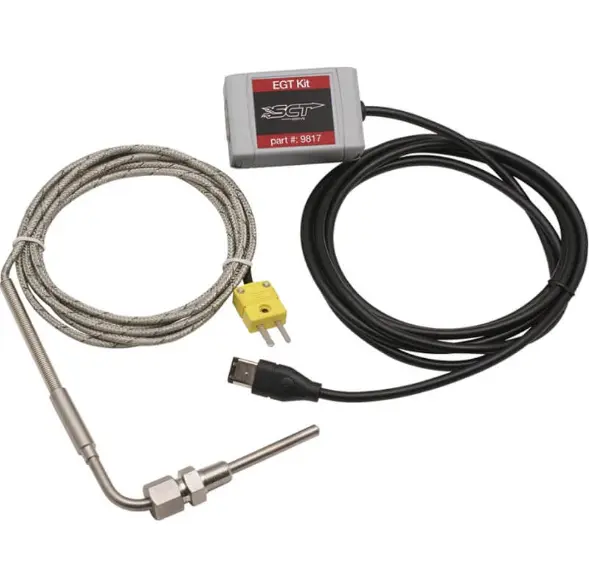


Engine Protection Kit: Cylinder Head Temperature Sensor (CHT) & EGT Probe
The Hongtai Engine Protection Kit is the ultimate monitoring solution for high-performance internal combustion engines. Whether you are managing a fleet of diesel generators, tuning a racing drone, or maintaining heavy marine vessels, precise thermal data is critical to preventing catastrophic engine failure.
Our kit includes two specialized sensors: the Cylinder head temperature sensor (CHT) for monitoring block thermals and the EGT sensor (Exhaust Gas Temperature) for combustion tuning. Unlike standard industrial probes that fracture under engine vibration, our Type K thermocouple for exhaust applications is engineered with an aerospace-grade Inconel 600 sheath and compacted MgO insulation, delivering a service life 5 times longer than standard stainless steel probes.
Key Technical Features & Performance
-
Vibration Proof Design: Engines generate high-frequency micro-vibrations that snap standard sensor wires. Our Diesel engine temperature probe features a highly compacted mineral insulated core that locks the internal wires in place, preventing fatigue failure.
-
Extreme Heat Resistance: The EGT sensor is rated for continuous operation at 1100°C (2000°F), allowing it to survive the hottest exhaust streams in turbo-charged and lean-burn engines.
-
Instant Response: Available with an Exposed Junction (for air/gas) or Grounded Junction, offering millisecond response times to detect dangerous “lean” conditions instantly.
-
Versatile Mounting:
-
Spark plug temperature sensor: Ring-terminal style fits directly under the spark plug or cylinder head bolt (10mm, 12mm, 14mm, 18mm sizes).
-
Exhaust Probe: Compression fitting (1/8″ NPT or M8) allows adjustable immersion depth in the exhaust manifold.
-
Technical Specifications
| Parameter | CHT Sensor (Head) | EGT Sensor (Exhaust) |
| Product Name | Cylinder head temperature sensor | Exhaust gas temperature probe |
| Calibration | Type K, Type J | Type K (Chromel-Alumel) |
| Temp Range | -40°C to 400°C | 0°C to 1100°C (2000°F) |
| Sheath Material | SS304 Braid / Washer | Inconel 600 / SS310 |
| Probe Diameter | N/A (Washer Type) | 3mm, 4.5mm, 6mm |
| Response Time | < 2.0 seconds | < 0.5 seconds (Exposed Tip) |
| Mounting | 10mm, 12mm, 14mm Ring | 1/8″ NPT, 1/4″ NPT Adjustable |
| Cable Protection | Stainless Steel Overbraid | SS Braid or Fiberglass Sleeve |
Why Monitor EGT and CHT?
-
Prevent Meltdown: A sudden spike in Exhaust gas temperature probe readings is the first warning sign of a lean fuel mixture or cooling system failure. Catching this early saves pistons from melting.
-
Fuel Efficiency: By tuning your engine based on EGT data, you can achieve the perfect air/fuel ratio, maximizing power while minimizing fuel consumption for Gensets and trucks.
-
Turbo Protection: High EGTs can destroy turbocharger turbine wheels. Our sensors allow ECU mapping to derate power if temps get too hot.
Installation Guide
-
For CHT: Simply remove the spark plug or a cylinder head bolt, place the Spark plug temperature sensor ring terminal over the hole, and re-torque the bolt. Ensure the sensor wire is routed away from the hot exhaust header.
-
For EGT: Drill and tap the exhaust manifold (header) approx 2-4 inches from the exhaust port. Install the compression fitting and slide the probe in until the tip is in the center of the gas flow. Tighten the ferrule to lock it in place.
FAQ
Q: Can I use this with my aftermarket ECU (MoTeC/Haltech)?
A: Yes. Our sensors are standard Type K thermocouples. They are compatible with almost all aftermarket ECUs, data loggers (AiM), and avionics systems (Dynon/Garmin) that accept Type K input.
Q: Why use Inconel 600 instead of Stainless Steel?
A: Stainless Steel 304 degrades rapidly above 800°C. Inconel 600 is a superalloy that retains strength and corrosion resistance up to 1150°C, making it mandatory for turbo diesel and racing applications.
Q: Is the probe bendable?
A: Yes, the probe section of the EGT sensor is a Mineral Insulated (MI) cable. You can bend it to a 90° angle to route it away from the firewall, provided the bend radius is at least 2x the probe diameter.
(Pair this with our Digital PID Controller for a standalone monitoring station.
Read about Exhaust Gas Temperature tuning theories.)