
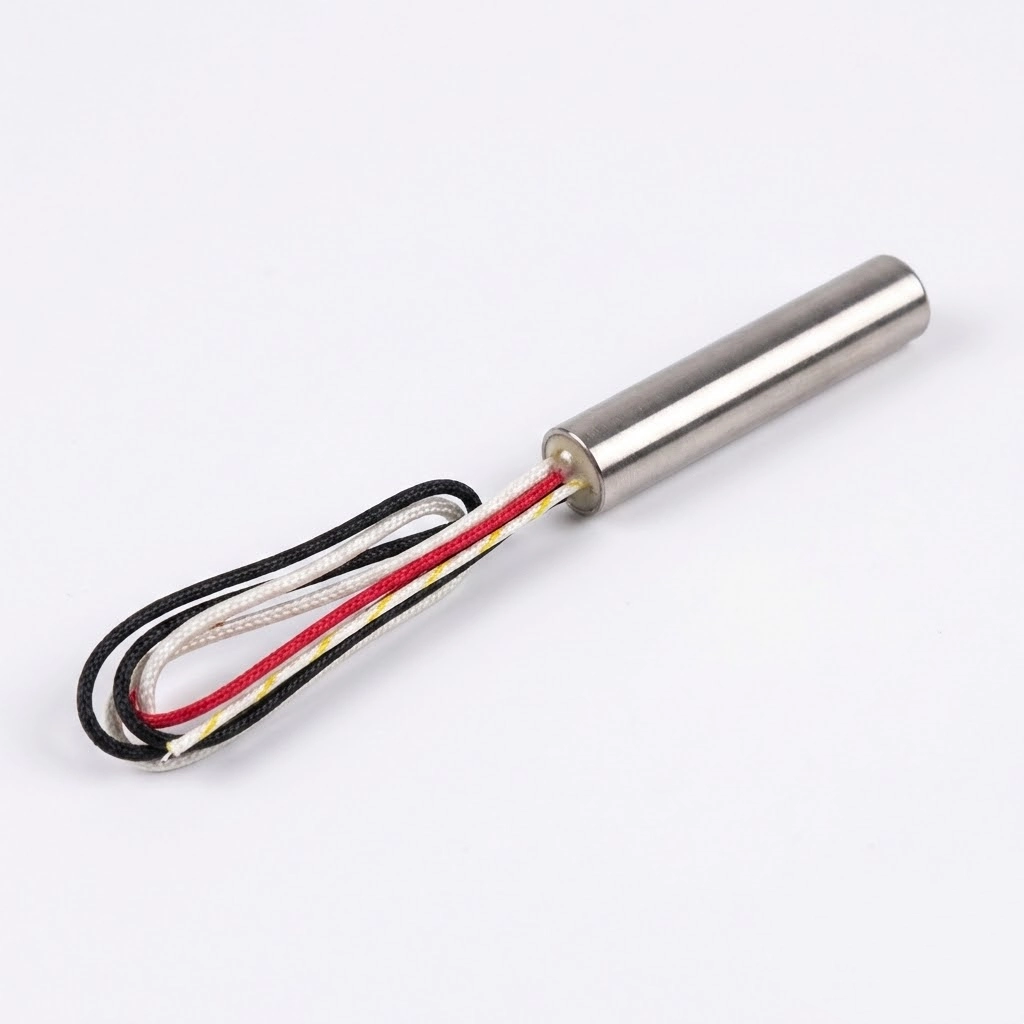
Internal Thermocouple Cartridge Heater (Type J / Type K)
Hongtai Cartridge Heaters with Thermocouples are the ultimate solution for applications requiring precise temperature monitoring and rapid thermal response. By integrating the temperature sensor directly inside the heater sheath, we eliminate the thermal lag often found with external sensors.
Designed for Hot Runner Systems, Injection Molding manifolds, and sensitive laboratory equipment, these built-in sensor heaters ensure the heat source and the control point are in perfect synchronization. Available with Type J (Iron-Constantan) or Type K (Chromel-Alumel) sensors, positioned either at the bottom disc or the middle of the heater.
Key Technical Features:
-
Sensor Type: Standard Type J (Yellow/Red) or Type K (Yellow/Red) calibration.
-
Junction: Grounded (Fast response) or Ungrounded (Noise immunity).
-
Position: Sensor placed at the disc end (standard) or distributed along the length.
-
Sheath Material: Stainless Steel 304/316 or Incoloy 800.
-
Precision: Diameter tolerance held to -0.02mm for optimal heat transfer.

1. Technical Specifications & Sensor Options
The following table outlines the standard configurations for heaters with internal sensors. We can adapt the lead wire configuration (separate sensor wires or multi-conductor cable) to fit your controller.
| Parameter | Standard Specification | Customizable Options |
| Thermocouple Type | Type J (0-750°C), Type K (0-1200°C) | PT100 RTD (Precision) |
| Junction Location | Bottom Disc (Tip) | Middle / Lead End |
| Junction Style | Grounded (Welded to sheath) | Ungrounded (Isolated) |
| Diameter | 6mm, 8mm, 10mm, 12mm, 1/4″, 1/2″ | Min 3mm – Max 25mm |
| Voltage | 24V, 120V, 230V, 240V | 480V |
| Lead Wire Protection | Fiberglass Sleeve | SS Braid / Armor Hose |
2. Why “Internal” Sensors Matter
-
Zero Thermal Lag: In high-speed injection molding, a delay of a few seconds in temperature reading can ruin a part. Internal sensors detect the heater’s core temperature instantly.
-
Space Saving: Eliminates the need to drill a separate hole for an external probe, simplifying mold design.
-
Overheat Protection: Placing the sensor in the middle of the heater acts as a high-limit safety device, preventing the element from burning out if the process runs dry.
3. Grounded vs. Ungrounded Junctions
-
Grounded (Standard): The thermocouple junction is welded directly to the heater sheath. This offers the fastest response time but is susceptible to electrical noise (EMF) from the heater coils.
-
Ungrounded: The junction is electrically isolated from the sheath using MgO. This is slightly slower but provides cleaner signals for sensitive PID controllers.
4. FAQ
Q: How do I identify the thermocouple wires?
A: Following ANSI standards: Type J has White (+) and Red (-) wires; Type K has Yellow (+) and Red (-) wires. However, international color codes vary (e.g., IEC/DIN), so please check the label or consult our wiring diagram.
Q: Can I replace a standard heater with a thermocouple version?
A: Yes, as long as your temperature controller supports the sensor input. You will save space by removing the old external sensor.
Q: What is the minimum diameter for a built-in sensor?
A: We can integrate thermocouples into pencil heaters as small as 4mm (5/32″) in diameter.